
Active Warrants in Summit County
Warrants in Summit County are issued by judges, not by police. A judge or magistrate signs the order, and then law enforcement acts on it. Courts that issue warrants here include the Court of Common Pleas, the county's municipal courts, and the Juvenile Court. Out-of-county and out-of-state courts can also place a warrant or holder that reaches a Summit County resident. Because the orders come from several courts, no one office keeps a master list of every live warrant.
The Summit County Sheriff's Office runs the unit that serves these orders. The Sheriff's Warrants Unit serves current and outstanding warrants within the county. Its page lists contact numbers and a short description of the unit, but it does not publish a searchable active-warrant database. So the honest answer is simple. There is no official countywide public warrant search form. To confirm a warrant, you call the issuing court or the Warrants Unit.
Court dockets can help. A live case in the clerk's index may show a warrant or capias entry on the case history. That is the closest thing to an online clue, but it is case by case. A warrant can be active in law enforcement systems even when a public docket has not caught up.
Types of Warrants in Summit County
Not every warrant means the same thing. The reason a court issued the order shapes how you handle it. Some warrants follow a fresh criminal charge. Others come from a missed court date or a broken court order. A few never reach the public at all until they are served. Here are the main types you may run into.
- Arrest warrant - issued to arrest a person accused of a crime, based on a sworn complaint or an indictment.
- Bench warrant / capias - signed by a judge after a failure to appear, a probation violation, or contempt of court.
- Search warrant - authorizes a search of a place, person, or property, and is often sealed until it is executed and returned.
- Fugitive warrant / holder - relates to an out-of-county or out-of-state pickup of a wanted person.
- Civil body attachment / contempt - can arise from a civil or family case when someone defies a court order.
Ohio law also gives officers another option for minor offenses. Under Ohio Rev. Code § 2935.26, an officer may issue a citation in lieu of arrest for many misdemeanors. That means not every minor case ends with a warrant or a jail booking.
Note: a search warrant may stay sealed until it is served, so it will not show up in a public search before that point.
How to Verify a Summit County Warrant Safely
Since no public form lists every warrant, verification means contacting an official source. Start with the court named on any paper you received, or call the Sheriff's Warrants Unit during business hours. Have a name, a date of birth, and a case number ready if you have one. Do not trust a third-party site that claims to show live warrants. The clerk has warned residents about fake sites, and the Sheriff posts scam warnings too.
- Identify the court that may have issued the order. Check any ticket, summons, or notice you got, since it names the court.
- Call the issuing court, or call the Summit County Sheriff's Warrants Unit at 330-643-5457 during weekday hours.
- Give your full name, date of birth, and case number if you have one, so the office can match the right record.
- If you cannot reach the court, you can check the clerk's public case index for a warrant or capias entry on a known case.
- Confirm the warrant is still active. A warrant may be recalled or quashed and still show on a stale unofficial database.
The Sheriff's Warrants Unit page is the official starting point for service questions. The screenshot below comes from that page.
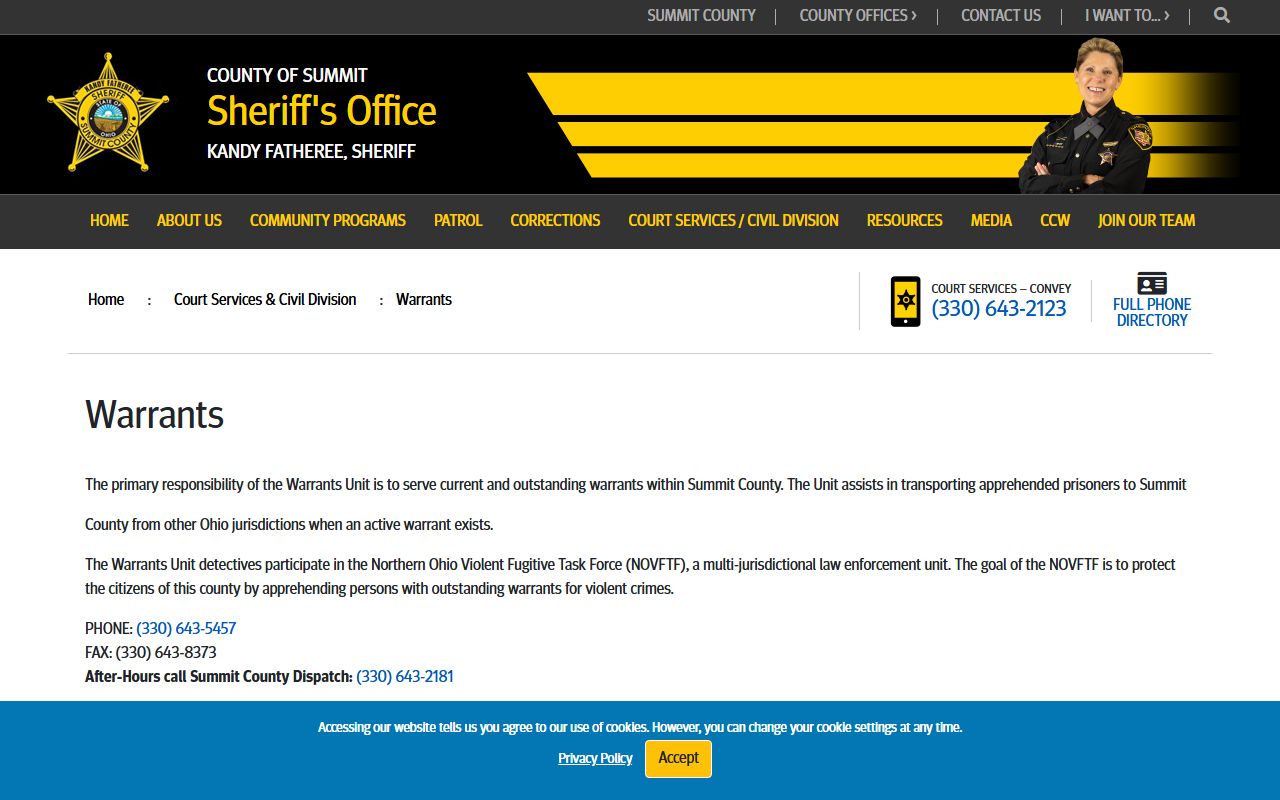
The page shows the unit serves current and outstanding warrants and helps transport people held in other Ohio jurisdictions. It does not offer a name search box. For after-hours matters, the page points to Summit County Dispatch.
What a Summit County Warrant Record May Show
Because there is no public warrant list, the closest record is a warrant or capias entry on a court docket. Those entries vary by court and case. When one appears on a live case, it may carry a set of fields drawn from the court order. The table below sums up the fields a docket-level warrant entry may include. Treat it as a guide, not a promise, since each court formats its own dockets.
| Field | What It May Show |
|---|---|
| Case Number | The case the warrant attaches to, used to confirm the right matter. |
| Defendant | The named person the warrant is issued against. |
| Issuing Court | The court that signed the order, such as Common Pleas, municipal, or juvenile court. |
| Warrant / Capias Date | The date the judge issued the warrant or capias. |
| Reason | The basis, such as a new charge, a failure to appear, a probation violation, or contempt. |
| Bond | The bond amount set, if any, and where it can be posted. |
| Return / Execution Status | Whether the warrant has been served or returned. |
| Recall / Quash Date | The date the warrant was recalled or quashed, if it has been. |
These fields must be verified from a live case. A warrant can be active in police systems before a docket updates. So a clean docket does not always prove there is no warrant.
How to Resolve an Outstanding Warrant
If you think a warrant is out for you, do not ignore it. A warrant does not go away on its own, and the longer it sits, the harder things get. The smart path is to confirm it through an official source, learn the terms, and plan your next move with help. The steps below come from the Sheriff's guidance and the issuing-court process. They apply to most adult warrants in the county.
- Do not ignore the warrant. Call the issuing court or the Summit County Sheriff's Warrants Unit to confirm it exists.
- Confirm your identity and the case number through official sources, not a caller or an unofficial website.
- Ask whether bond is set and where it can be posted.
- If the warrant is for a failure to appear or contempt, ask whether the court allows a walk-in appearance, a motion to recall, or a new hearing date.
- For a felony or probation warrant, contact a lawyer before you appear if you can.
- Never pay a caller by gift card, crypto, wire, or an unofficial site. The clerk warns about fraud, and the Sheriff posts scam warnings.
Important: Talk to a lawyer before you turn yourself in, especially on a felony or probation warrant, so you understand bond, charges, and your rights first.
Summit County Sheriff's Warrants Unit
The Warrants Unit sits inside the Sheriff's Court Services and Civil Division. Its job is to serve current and outstanding warrants in the county and to transport people held in other Ohio jurisdictions back to Summit County when an active warrant exists. The unit's detectives also join the Northern Ohio Violent Fugitive Task Force, a multi-agency team that targets people wanted for violent crimes. Not every county warrant runs through that task force, though. Routine bench warrants are handled by the unit itself.
Sheriff's Warrants Unit
County of Summit Sheriff's Office
209 S. High Street
Akron, OH 44308
Warrants Unit: 330-643-5457
Court Services: 330-643-2123
Fax: 330-643-8373
After hours: 330-643-2181
Mon-Fri 8:00 a.m.-4:00 p.m.
The Warrants Unit is separate from the unit that serves civil court papers. The Service and Return Unit handles Common Pleas court documents, both local and from other jurisdictions. Its page appears below.
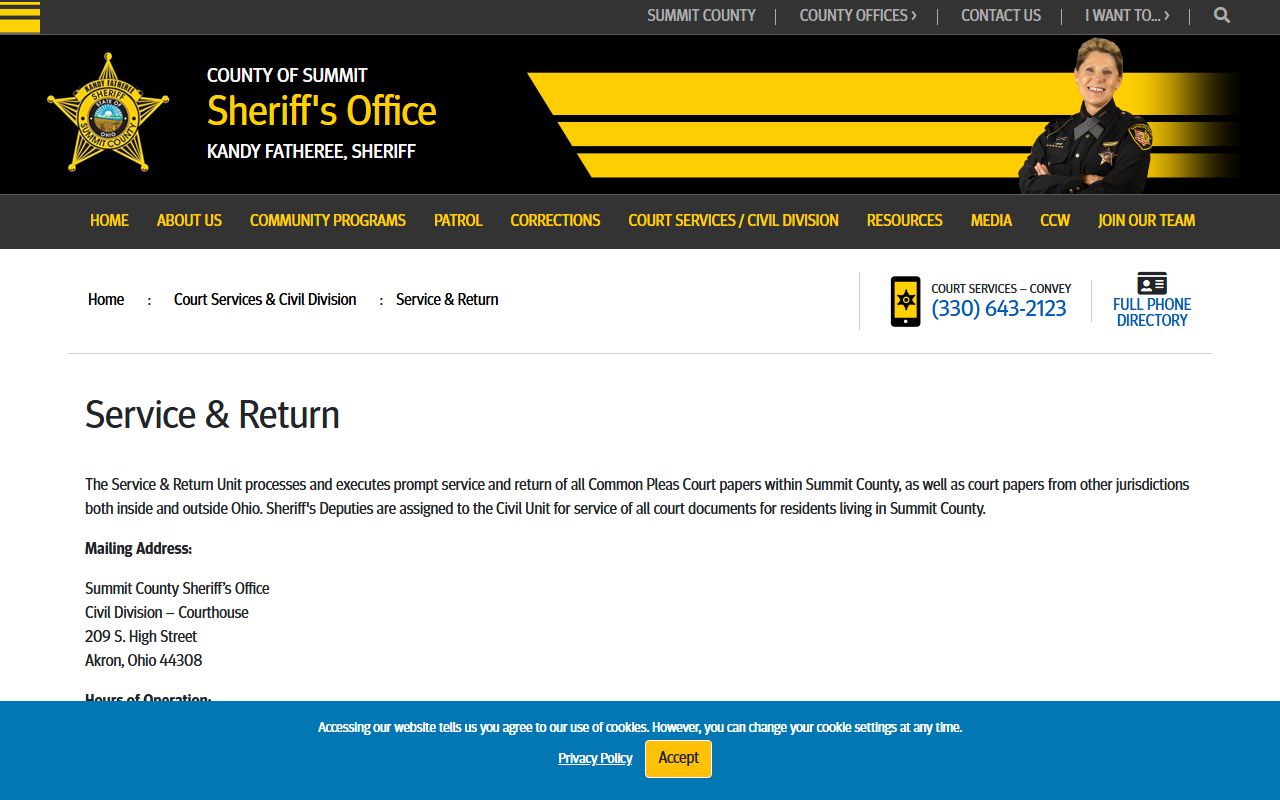
For deeper detail on the office that runs the jail and serves these orders, see the Summit County Sheriff's Office homepage. Sheriff Kandy Fatheree leads the office.
Warrant Scams and Fraud Warnings
Warrant scams hit Summit County residents often. A caller claims you missed jury duty or have a warrant, then demands fast payment to clear it. Real courts and the Sheriff do not work this way. The clerk has warned the public about a fake website that copied its name, and the clerk's office says it does not take online payments of any kind. The Sheriff posts scam warnings too. Any site or caller asking for card details or gift cards to "clear" a warrant is a fraud.
The safe move is to hang up and verify on your own. Call the court or the Warrants Unit using the numbers on an official site, not a number a caller gives you. Do not pay anyone over the phone for a warrant. A legitimate process runs through the court, with a bond posted at the proper place, not through a wire transfer or crypto.
Note: No court or Sheriff will ask you to clear a warrant by gift card, crypto, wire, or an unofficial records site, so treat any such demand as a scam.
Restricted Summit County Warrant Records
Some warrants are not open to the public. A search warrant is often sealed until it is served and returned to the court, so it stays out of view in the early stage. Juvenile warrants are not public in the same way adult warrants are, since Ohio juvenile law limits access to youth records. Federal warrants are a separate matter handled by federal agencies, not the county Sheriff.
There is one more limit to keep in mind. A warrant can be recalled or quashed, yet a stale unofficial database may still show it as active. That is one reason to confirm with the issuing court before you act. To check whether a warrant connects to a person already in custody, use the Summit County inmate records roster. For the charges behind a case, see arrest records. To read the full case file and its docket, start with Summit County court records.