
How to Find Recently Released Summit County Inmates
The Summit County Sheriff's Office runs the county jail and posts a current inmate roster. That roster is the first place to look, but it only shows people held right now. It does not list past releases. So if you knew a person was in the jail and you no longer find them, that tells you something changed. It does not tell you what. The roster is a point-in-time PDF report, not a live release archive.
When a name leaves the active roster, several things could explain it. Knowing the options keeps a search from going wrong. Here are the common paths a person can take out of the Summit County Jail:
- Released on bond or on their own recognizance.
- Released after the case ended or a sentence was served.
- Moved to another county on a warrant or hold.
- Sent to an Ohio prison after sentencing, which then shows up at the Ohio DRC.
- Held on a federal matter or moved to federal custody, which the Bureau of Prisons tracks.
- Placed on community supervision, where Adult Parole Authority status may apply.
Because the roster cannot confirm a release on its own, cross-check the criminal case docket. The Summit County inmate records page explains how the roster works field by field. The clerk's criminal case docket may show bond, release, or sentencing entries that fill in the gap. For full case history, the Summit County court records search covers Common Pleas filings.
Note: a person can vanish from the jail roster within hours of a release or transfer, so the roster alone never proves where someone is now.
Setting Up Release Notifications
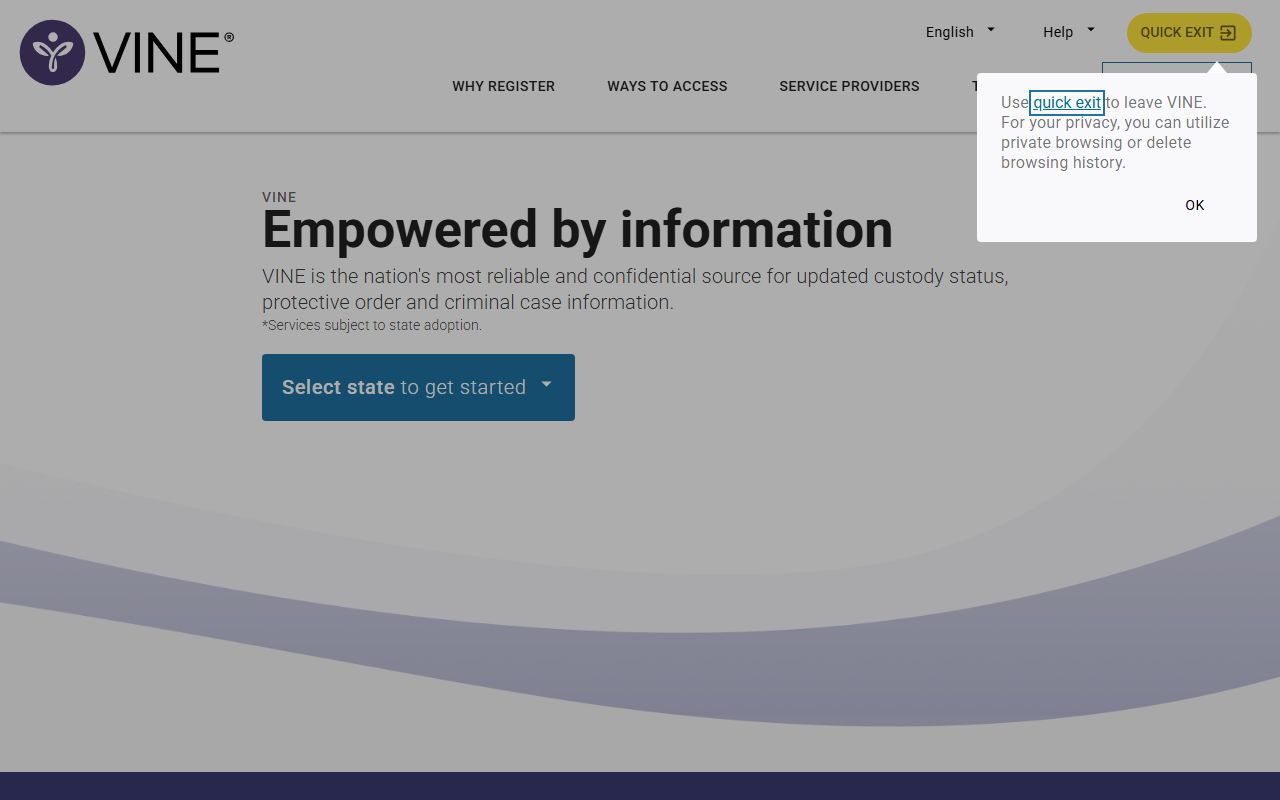
Waiting and refreshing a roster is no way to track a release. The better tool is VINELink, the national custody notification service. VINELink lets you register a phone number or email and get an alert when a person's custody status changes. It calls itself the nation's source for updated custody status, protective order, and criminal case information. Service depends on each state and jurisdiction joining the feed, so coverage can vary. You can reach it at vinelink.com.
The screenshot below comes from the VINELink custody notification portal. It shows the front page where a search starts.
Setting up an alert takes only a few minutes. Follow these steps to register on VINELink:
- Open VINELink and choose Ohio or the jurisdiction holding the person.
- Search by name or ID, depending on what the state feed allows.
- Pick the right record from the results and start the registration.
- Enter a phone, email, or text contact and confirm how you want alerts sent.
The search fields shift a little by state, but the core layout stays the same. The table below lists the main VINELink fields.
| Field Label | Type | Required | Notes |
|---|---|---|---|
| State / Jurisdiction | Dropdown / map | Yes | Select Ohio or the relevant jurisdiction first. |
| Name / ID Search | Text | No | Search by offender or inmate name or ID, based on the state feed. |
| Facility / Location | Dropdown / text | No | Varies by jurisdiction. |
| Registration / Contact | Account fields | For alerts | Phone, email, and text options vary. |
Searching State and Federal Released Inmates
Not everyone who leaves the Summit County Jail simply goes home. A person sentenced to prison time moves into the state system. After sentencing in the Court of Common Pleas, the state takes custody, and the local roster no longer applies. For these cases, the Ohio Department of Rehabilitation and Correction runs a public Offender Search at appgateway.drc.ohio.gov/OffenderSearch. It covers prison custody and Adult Parole Authority supervision.
The Ohio DRC search has a useful feature for released-inmate lookups. The Status filter lets you pick All, Incarcerated, Released, APA Supervision, or Violators at Large. That means you can search directly for someone marked Released. The table below lists the Ohio DRC search fields.
| Field Label | Type | Required | Notes |
|---|---|---|---|
| Last Name | Text | No | Last name alone works; "Brown" returns names that begin with Brown. |
| First Name | Text | No | Narrows last-name results. |
| County of Commitment | Dropdown | No | Sentencing county, such as Summit. |
| Residential County | Dropdown | No | Searches APA Supervision and Violators at Large. |
| Zip Code | Text | No | Searches supervision and Violators at Large only. |
| Status | Radio | No | All; Incarcerated; Released; APA Supervision; Violators at Large. |
| Next Parole Board Hearing Date | Text | No | Format YYYYMM, such as 202604 for April 2026. |
| Number | Dropdown + text | No | Offender number search. |
| Sort Results By | Dropdown | No | Sort control for the result list. |
A result record shows more than a name. It builds a full picture of the person and the case. The fields below are what an Ohio DRC record can return.
| Field | What It Shows |
|---|---|
| Name and Number | The person's name and Ohio DRC offender number. |
| DOB, Gender, Race | Basic identity details to confirm the right match. |
| Admission Date | When the person entered state custody. |
| Institution | The prison or facility, or the supervision detail. |
| Status | Incarcerated, Released, APA Supervision, or Violator at Large. |
| Offense Information | Offense name, counts, ORC, sentence terms, county, docket, and judge. |
| Photo | A booking-style photo on many records. |
Federal cases run on a separate track. When a Summit County arrest turns into a federal charge, or a person is moved to federal custody, the Federal Bureau of Prisons Inmate Locator is the right tool. It covers federal inmates held from 1982 to the present. You can reach it at www2.fed.bop.gov/Locate. The screenshot below is the Federal Bureau of Prisons inmate locator.
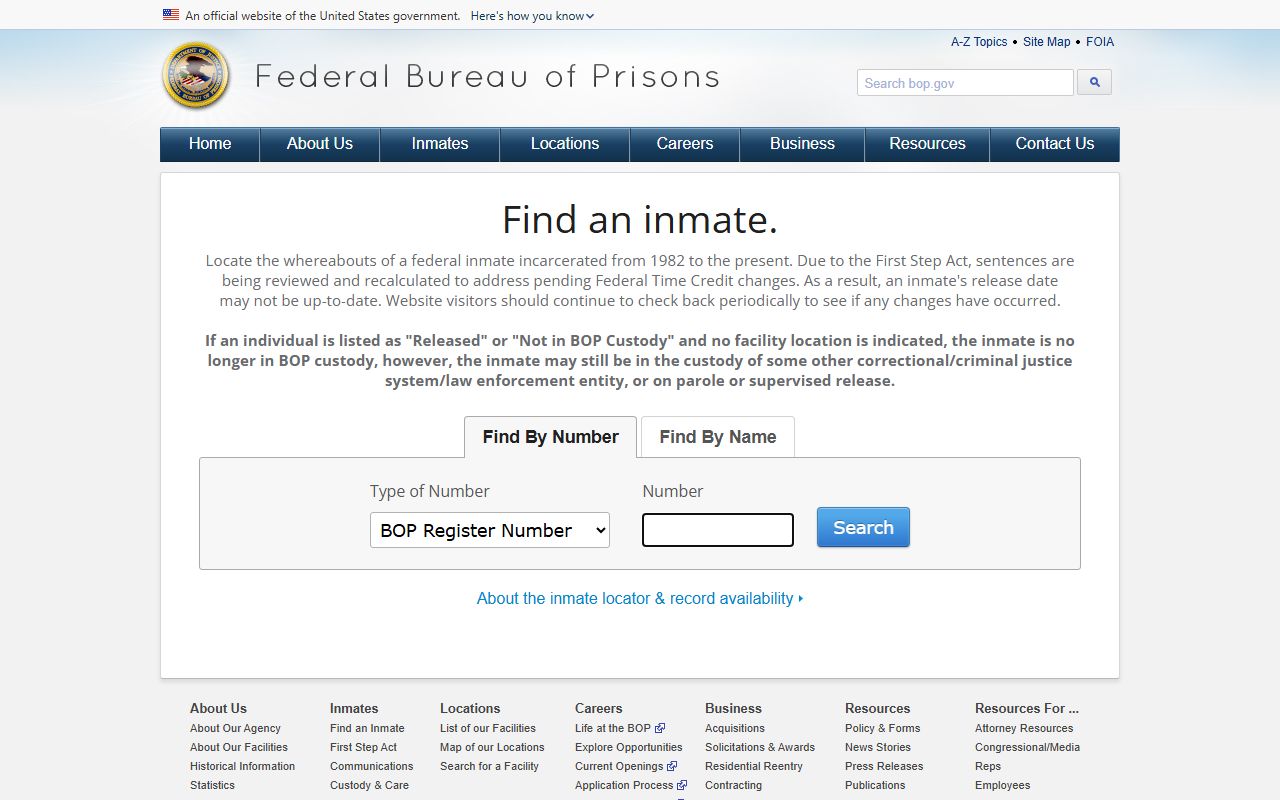
The BOP page splits its search into two paths. You can find a person by a number or by name. The table below lists the BOP locator fields.
| Field Label | Type | Required | Notes |
|---|---|---|---|
| Find by Number | Radio / section | No | BOP Register, DCDC, FBI, or INS number. |
| Find by Name | Section | No | First, Middle, Last, plus Race, Sex, and Age. |
| Search | Button | Yes | Submits the locator. |
| Clear Form | Button | No | Clears the entered fields. |
The U.S. Department of Justice keeps a single portal that links the federal inmate and sex offender locators in one place at justice.gov. The BOP search does not replace a Summit County jail check, though. Local custody and federal custody are different systems with different records.
Verifying Release in Person or By Phone
Online tools are a starting point, not the final word. For anything that matters, confirm a release with a live source. The Summit County Jail runs an automated corrections line that operates around the clock. A phone call settles questions a roster cannot, such as whether a person was released today, transferred, or still held in the county. The jail sits on East Crosier Street in Akron, a short drive from the downtown courthouse.
Use the contact below to verify custody and release status by phone.
Summit County Jail (Corrections)
205 East Crosier Street
Akron, OH 44311
Corrections line: 330-643-2171
Sheriff's Office: 330-643-2154
If the jail cannot help, the case file often can. A criminal docket in the Court of Common Pleas may log a release order, a bond posting, or a transfer to prison. For misdemeanor or traffic matters, the case likely began in a municipal court, so check there. To find active holds tied to a name, the Summit County warrant records page explains how to verify safely.
Note: Never approach or pick up a person based only on an online status; confirm the release first with the jail or the court that handled the case.
The Sex Offender Registry
Some released people carry registration duties. After certain offenses, Ohio law requires a person to register and stay listed in a public database. The Summit County Sheriff's Office links a Search Sex Offender Registry tool from its official resources section. The registry helps neighbors, schools, and employers check whether a released person must register and where they live.
Ohio's sex offender law sits in Chapter 2950 of the Revised Code. That chapter sets the tiers, the registration terms, and the reporting rules. The Sheriff handles local registration and verification for Summit County. The registry is a separate system from the jail roster and the case docket, so it can show a person who left custody long ago.
A registry search usually accepts a name or a location. The table below lists the common search fields.
| Field Label | Type | Required | Notes |
|---|---|---|---|
| Last Name | Text | No | Search by a registrant's last name. |
| First Name | Text | No | Narrows a name search. |
| ZIP / Radius | Text | No | Find registrants near an address or area. |
| County / City | Dropdown / text | No | Limit results to Summit County or a city. |
Parole and Probation Information
Release rarely means a clean break from the courts. Many people leave custody under supervision. Probation is supervision in place of, or after, a jail or prison term, run through the court. Parole and post-release control are state supervision handled by the Ohio Adult Parole Authority, part of the Ohio Department of Rehabilitation and Correction. The Ohio DRC Offender Search shows an APA Supervision status for state cases, which is one way to confirm someone is on supervision rather than fully free.
Supervision comes with rules. A person may need to report, stay in the area, avoid new charges, and meet treatment terms. A breach can lead to a violation and a return to custody. The Ohio DRC search also marks Violators at Large, people wanted for skipping supervision. The clerk's criminal docket in Summit County records probation terms and any violation hearings for local cases.
The Court of Common Pleas also runs a Reentry Court as one of its specialty dockets. This kind of docket pairs court oversight with treatment and support for people returning from incarceration. The Summit County arrest records page covers how charges and supervision connect in the criminal system.
Note: parole and probation are different things, so confirm which one applies before assuming what rules a released person must follow.
Reentry Resources in Summit County
Leaving custody is hard, and Summit County offers help for the road back. Reentry work aims to lower the odds a person returns to jail. It links housing, jobs, treatment, and legal aid. Some of this help starts inside the jail, and some waits on the outside. The county pairs court programs with community groups to cover both.
The local reentry options come from a few strong sources. Each plays a different part:
- The Sheriff's I.G.N.I.T.E. program, launched in January 2026, brings education and skills training into the jail to cut repeat offending.
- The Common Pleas Reentry Court, a specialty docket, supports people meeting supervision, treatment, and court terms after release.
- The University of Akron reentry and expungement clinic, linked by the clerk, helps with sealing records and legal barriers.
- Community Legal Aid serves low-income residents with civil matters that follow people home.
- Ohio DRC reentry resources support people coming back from a state prison term.
A sealed or expunged record can clear a path to jobs and housing, so legal help matters as much as a place to stay. Ohio's sealing rules run through the Court of Common Pleas, and the clerk processes the motions. For the records side of a case, the Summit County court records search shows what is on file and what may qualify for sealing.
Civil Rights Restoration After Release
Release does not restore every right at once. Ohio treats each right on its own terms, and the conviction can matter. Voting, jury service, firearm possession, professional licensing, housing, and driving are all governed by separate rules. So a person may regain one right while another stays limited. It pays to check each one rather than assume.
Voting is the clearest case. Ohio generally restores the right to vote once a person finishes a prison term and leaves incarceration. People on probation or parole who are not behind bars are often able to register. Anyone unsure of their status should confirm current rules with the Ohio Secretary of State before they rely on it. Firearm rights are far more complex. A conviction can create a state or federal firearm disability, and getting that lifted is not automatic. It can take a court process and legal advice.
Rights after release vary: Ohio handles voting, jury service, firearm possession, licensing, housing, and driving under separate rules, so check each right for the specific conviction rather than treating them as one.
Sealing or expunging a record is the strongest tool for moving forward. A sealed case should drop out of an ordinary clerk search and ease background-check problems. The University of Akron clinic and Community Legal Aid both help here. For the broader population and trends behind these numbers, see the Summit County inmate population page.
Related Searches
Custody questions often touch more than one record. To check the current jail roster, use Summit County inmate records. For capacity and population data, see inmate population. To verify active holds, the warrant records page explains a safe lookup. For charge and case history, start with arrest records. Free federal filings, though not the official record, are at CourtListener, shown below.
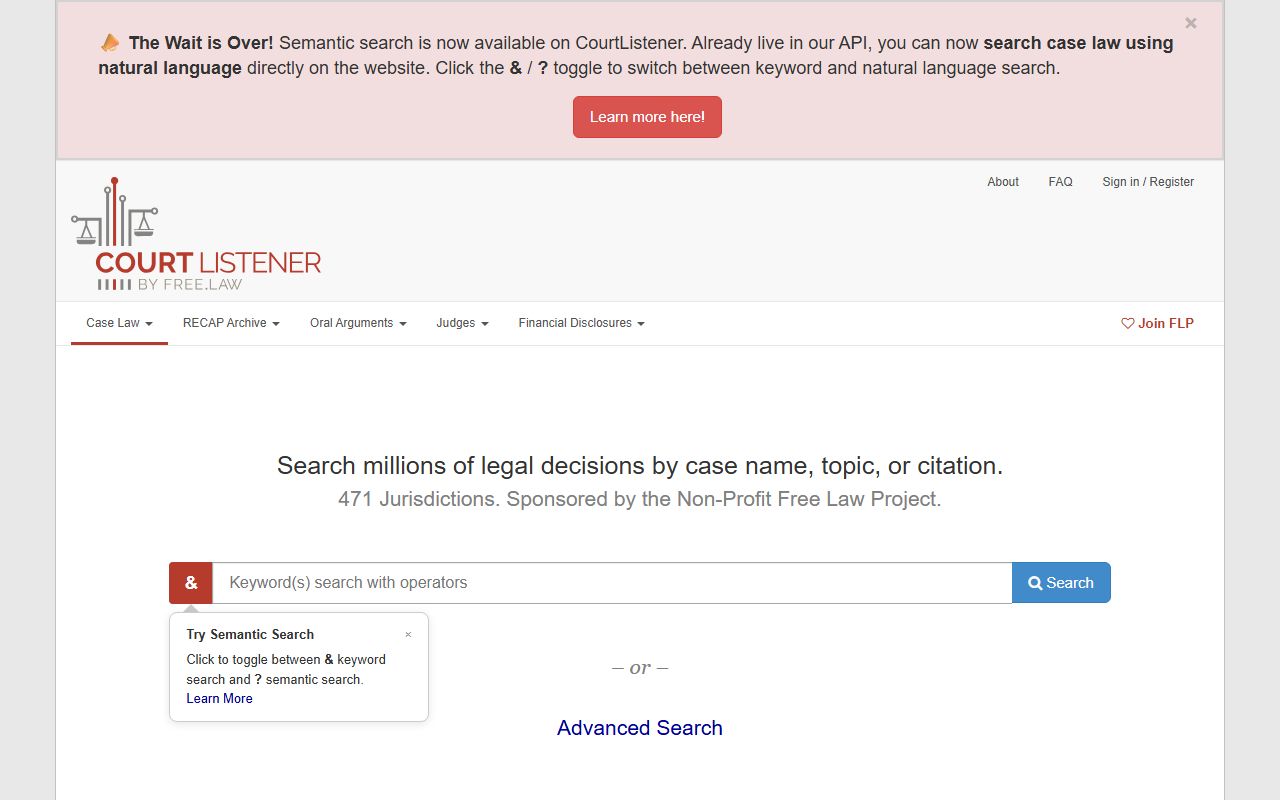
Use the official locators first, then treat free archives as a backup for federal case context only.