
Arrest Records in Summit County
An arrest record is the paperwork created when police take a person into custody and book them into jail. In Summit County, most of these records start with the Summit County Sheriff's Office and the county jail. City police such as the Akron Police Department also make arrests, and those people are often booked into the county jail too. The record at booking notes who was arrested, when, by which agency, and on what charge. It is law enforcement data, separate from any court file.
Booking is not the same as a conviction. A booking simply means a person was arrested and entered into the jail system. The charge listed is an accusation. To learn the outcome, you have to check the court docket, which is a different record kept by the Clerk of Courts. Felony cases run through the Court of Common Pleas General Division, and those files live on the Summit County court records page. Arrest data and court data connect through charge statutes and case numbers, but they are not the same file.
How to Search Summit County Arrest Records
The fastest way to find a recent arrest is the sheriff's inmate roster. The Summit County Sheriff publishes a current jail roster as a PDF called the Head Count With Photos Report. It is not a typed-in search form. It is a long report you open and then scan with your browser's find tool. The roster lists each person in the jail right now, with a photo, the booking details, and the charge. The image and links below come from the Summit County Sheriff's Office site.
- Open the sheriff site and find the Corrections section, then the Current Inmate Roster link.
- Open the Head Count With Photos Report PDF. It can run close to 200 pages.
- Use your browser find tool (Ctrl+F or Command+F) to search by last name, inmate number, or charge statute.
- Read the row for the booking date and time, the arresting agency, the statute, and the bond amount.
- To see how the case is going, copy the name or case number and search the court docket through the Clerk of Courts.
For a felony case already in court, search the criminal division through the Summit County Clerk of Courts case search. A name search in the criminal division needs at least the first three letters of the last name. A criminal case number starts with CR plus three numeric parts. The roster shows the arrest. The clerk shows the case.
What the Jail Roster Shows
The Head Count With Photos Report carries a fixed set of fields for each person in custody. Because it is a point-in-time report, it can lag behind a release or a transfer by a few hours. If the data matters, call the jail to confirm. The roster does include a booking photo for each inmate, which is the mugshot many people are looking for. The table below lists the fields the report shows and what each one means.
| Field | What It Shows |
|---|---|
| Inmate No | The jail's numeric ID for the person in custody. |
| Assigned Housing | The unit or pod, such as 1A10U, 3A13L, or WEST GYM. |
| Inmate Name | Last, first, middle or suffix. |
| DOB | Date of birth in month, day, year. |
| Race / Sex | Short letter codes, such as W or B, and M or F. |
| Arrest Date / Time | When the booking arrest took place. |
| Agency | The arresting agency, such as APD, SCSO, BPD, or OSP. |
| Statute / Description | The charge code and a short description of the offense. |
| Bail / Bond | The set bond amount, such as $5,000.00 or $100,000.00. |
Note: the roster is a current head count, not a release archive, so a name that drops off may mean a release, a transfer, or a different listing.
Arrest Records vs. Criminal Court Records
People mix up these two records all the time. An arrest record is made at booking by law enforcement. A criminal court record is made later, by the Clerk of Courts, once the prosecutor files charges. One can exist without the other. A person can be booked and released with no case ever filed, and a case can be filed by summons with no jail booking at all. The table below sets them side by side.
| Arrest Record | Criminal Court Record | |
|---|---|---|
| Source | Sheriff or city police | Clerk of Courts |
| Created When | At booking | When charges are filed |
| Contents | Booking data, charge, mugshot, bond | Indictment, pleas, motions, disposition |
| Where to Find It | Sheriff inmate roster | Clerk criminal case search |
| Shows Outcome | No | Yes |
If you only check the arrest side, you miss the result. The full case history, including the plea and sentence, sits in the court file. For that, use the Summit County court records page.
Charges vs. Convictions
A charge is an accusation. A conviction is a finding of guilt. The two are not the same, and the gap between them matters a great deal for anyone reading an arrest record. To arrest someone, police need probable cause. To convict someone, the state must prove guilt beyond a reasonable doubt. Many charges never become convictions. Cases get dismissed, reduced, or end in a not-guilty finding. The arrest still shows up at booking, but the court record tells the real result.
| Charge | Conviction | |
|---|---|---|
| Stage | Accusation at arrest or filing | Verdict, plea, or finding |
| Burden of Proof | Probable cause | Beyond a reasonable doubt |
| Decided By | Police or prosecutor | Judge or jury |
| Final? | No, can change | Yes, unless appealed |
Some Ohio misdemeanors and traffic offenses use a citation in lieu of arrest. Under Ohio Rev. Code § 2935.26, an officer can issue a ticket and let the person go instead of booking them into jail. In that case there is a court charge but no jail booking record. Serious OVI and drunk-driving matters can run as criminal cases, and those overlap with Summit County traffic court records.
The Prosecutor's Role
An arrest does not file a case. The prosecutor does that. The Summit County Prosecutor decides which charges to bring after police make an arrest. The current prosecutor is Elliot Kolkovich, elected to a full term in November 2024. His Criminal Division handles felony cases committed within the county. Office staff meet daily with the Akron City Prosecutor and city liaison officers to review the prior day's arrests, which is one way a booking turns into a formal charge.
The prosecutor can also decline to charge, reduce a charge, or send a case to a grand jury. A grand jury can return an indictment, which is the formal felony charging document. You can read more about the office on the Summit County Prosecutor Criminal Division page. The decision to charge is what moves a matter from a sheriff's roster entry to a court case.
Mugshots and Booking Photos
A mugshot is the booking photo taken when a person is processed into the jail. In Summit County, the booking photos appear right inside the sheriff's Head Count With Photos Report, next to each inmate's name and charge. The jail uses video imaging for mug shots and electronic fingerprinting as part of its booking technology. So the official source for a current Summit County booking photo is the sheriff's own roster, not a private mugshot site.
Be careful with third-party mugshot sites. They copy booking photos and sometimes charge money to take them down. The photo on the official roster only stays while the person is in custody. Once someone is released, they drop off the current report. The safest path is to read the booking photo straight from the sheriff's roster, then check the court docket to learn what happened with the charge.
Common Arrest and Booking Terms
Arrest and court records use a lot of shorthand. A few terms come up again and again when you read a booking entry or follow a case from arrest to disposition. Here is what they mean in plain language.
- Arraignment
- The first court hearing after an arrest, where the charge is read and a plea and bond are set.
- Bond
- Money or a condition set for release while a case is pending. The roster lists a bond amount for many inmates.
- Capias
- A court order to take a person into custody, often after a missed hearing. A bench warrant is similar.
- Indictment
- A grand jury's formal felony charge. An information is a similar charge filed by the prosecutor.
- Disposition
- The outcome of the charge, such as a dismissal, plea, or sentence.
If a booking entry shows a statute of 000, that often points to a contempt or court-order hold rather than a new street charge.
Sealed vs. Expunged Records
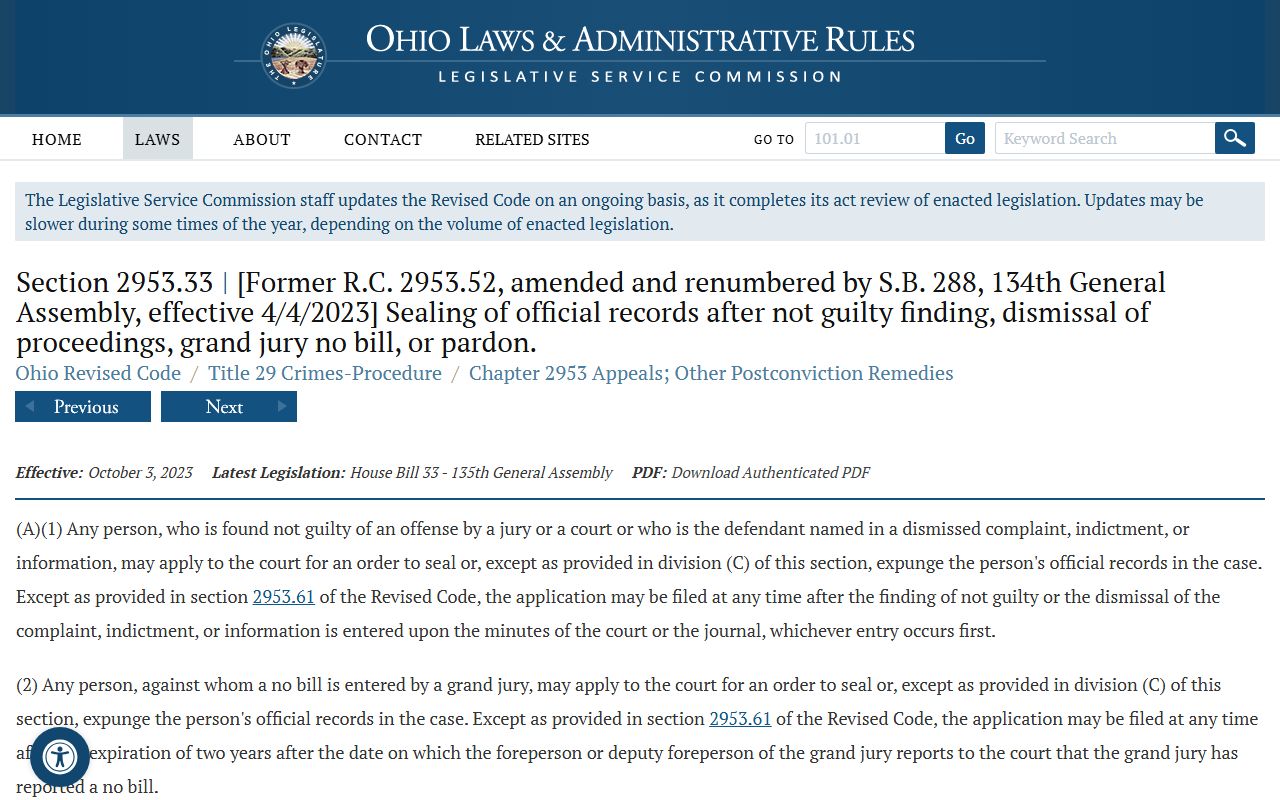
Ohio law lets some people clear an old record from public view. There are two paths, and they are not the same thing. Sealing removes a record from ordinary public access, though certain agencies can still see it. Expungement goes further and can destroy or delete the record. The screenshot below is the official Ohio statute on sealing after a not-guilty finding, dismissal, or no bill, from Ohio Rev. Code § 2953.33.
| Sealed | Expunged | |
|---|---|---|
| Visibility | Hidden from ordinary public view | Destroyed or deleted where allowed |
| Law Enforcement | Limited access by listed agencies | Very limited access |
| Governing Law | ORC 2953.32 (convictions) | ORC 2953.32 / 2953.34 |
| Non-Conviction Path | ORC 2953.33 | ORC 2953.33 |
Conviction sealing falls under Ohio Rev. Code § 2953.32, while the effect of sealing and who may still inspect a sealed record is set by Ohio Rev. Code § 2953.34. To start the process, use the Summit County sealing packet from the Clerk of Courts. The packet lists a $100 filing fee for each motion, filed with the Clerk's Criminal Division at 205 South High Street, Akron. The prosecutor may object, and the court weighs eligibility, waiting periods, and the public interest.
Note: a sealed Summit County case should not show up in a normal clerk search, so missing results do not always mean no record ever existed.
Background Check Considerations
There is a difference between a casual lookup and a formal background check. Reading the jail roster or a court docket is a casual lookup. A formal background check for a job, a license, or a gun purchase usually runs through a fingerprint-based state and federal search. The Summit County Sheriff offers fingerprinting and background-check service as one of its public resources. Statewide criminal history in Ohio comes from a fingerprint search run through the Ohio Attorney General's Bureau of Criminal Investigation, often called WebCheck.
An employer or landlord that uses a background report for a hiring or housing decision must follow the federal Fair Credit Reporting Act. A free online roster lookup is not an FCRA-compliant report and should not be used for those decisions. Use a licensed screening service when the law requires it.
Important: This website is not a consumer reporting agency under the FCRA, and its data may not be used for credit, employment, tenant, or insurance decisions.
Restricted Criminal Records in Summit County
Open access has limits. Several kinds of arrest and criminal records are closed or heavily redacted under Ohio law. Juvenile records are restricted by statute and usually reach only parties, counsel, agencies, or someone with a court order. Sealed and expunged adult records should not appear in a normal clerk search. The clerk also redacts personal identifiers such as Social Security numbers and the names and addresses of crime victims in criminal cases.
Records tied to an open investigation can also be withheld for a time. The Ohio Public Records Act, found at Ohio Rev. Code § 149.43, gives the public a right to inspect government records, but it carries exemptions, and the Supreme Court of Ohio rules govern court files. If you believe a record exists but cannot see it, ask the office that holds it. For a sealed case, only the court that handled it can grant access, and only on proper grounds.
Summit County Jail Contact
The county jail handles booking and holds the people listed on the arrest roster. For a current custody, release, or transfer status that the point-in-time PDF may not show yet, the jail's corrections line is the place to call. The booking facility and the sheriff's main office are at separate addresses in Akron.
Summit County Jail
205 East Crosier Street
Akron, OH 44311
330-643-2171
Corrections automated line
The jail runs every hour of every day, with a capacity of 671 inmates. Booking happens around the clock, so the roster can change at any time.