
About the Summit County Clerk of Courts
The Summit County Clerk of Courts is a county office led by Clerk Tavia Galonski. The Clerk is the recordkeeper and filing office for the courts it serves. It is not a court. Judges decide cases. The Clerk takes the filings, keeps the docket in order, issues court process, collects fees, and fills public records requests. That split matters when you call. Staff can point you to a record or explain a procedure, but they cannot tell you what to do in a case.
The office is built around two divisions. The Legal Division keeps the case records. The Title Division and Passport Acceptance Agency handles vehicle and watercraft titles plus passport service. Together they cover a lot of ground, from felony case files to a new passport photo. For court records, the Legal Division is the one you want. It serves the Common Pleas General Division, the Domestic Relations Court, and the Ninth District Court of Appeals.
Summit County Clerk of Courts, Legal Division
Clerk: Tavia Galonski
205 S. High Street
Akron, OH 44308
330-643-8082 (public records help)
330-643-2741 (records request questions)
Mon-Fri 7:30 a.m.-4:00 p.m.; e-filing 24/7
The Two Divisions of the Clerk's Office
The Legal Division is the court records arm. It maintains files for the Common Pleas General Division, the Domestic Relations Court, and the Ninth District Court of Appeals. It also keeps naturalization records, with a separate historical search that reaches back from 1850 through 1991. That older set is a real find for family history work. The Legal Division sits downtown at 205 S. High Street in Akron, open on weekdays from 7:30 a.m. to 4:00 p.m. Its e-filing portal runs around the clock, even when the counter is closed.
The Title Division and Passport Acceptance Agency is the second arm. It runs three locations across the county. Title work is walk-in. Passport service is by appointment only. Title records follow a separate public-record policy tied to state BMV privacy rules, so the process there is not the same as a court file request. The screenshot below comes from the official Summit County Clerk of Courts civil records menu.
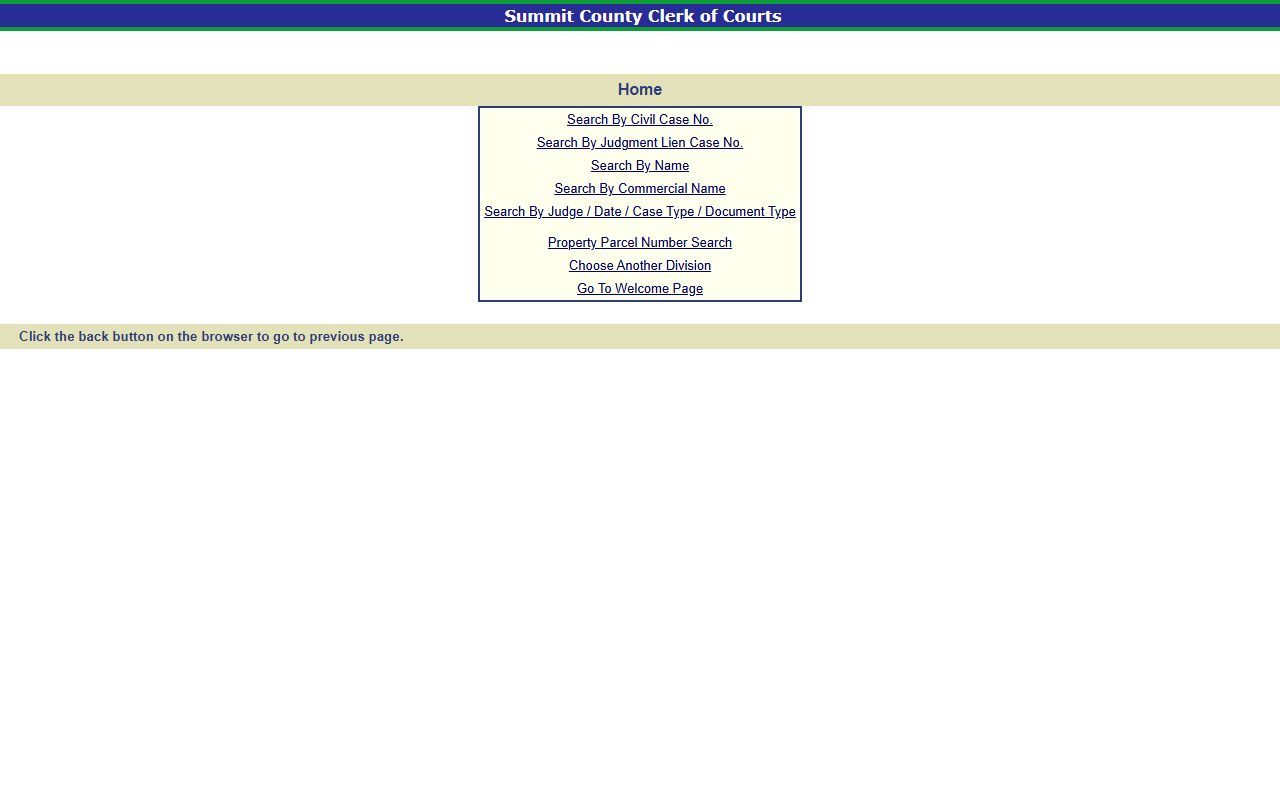
That civil menu is just one division. The full search starts at a division selector that lists Civil, Criminal, Domestic, Court of Appeals, and Naturalization. Each division keeps its own index, so the first step in any search is to match the case to the right one.
Note: civil case search runs on a newer system, while criminal, domestic, and appellate searches use an older one, so the screens look a little different.
What the Clerk Does in Summit County
The Clerk of Courts handles the paper trail of a case from start to finish. Every motion, order, and entry passes through the office and lands on the docket. The Clerk also takes fees, issues summonses, and certifies copies when someone needs an official version. Court records from 2002 to the present are online for free, which is why the office tells the public to search first and request later.
The main duties of the office include:
- Accept and file civil, criminal, domestic, and appellate court documents.
- Keep the official docket and case index for the courts it serves.
- Issue certified and plain copies of court records on request.
- Answer public records requests under Ohio court rules and the Public Records Act.
- Run e-filing for attorneys and parties around the clock.
- Keep naturalization records from 1850 through 1991.
For broader county records that are not court files, see public records. For the courts the Clerk serves, see the Court of Common Pleas page.
Avoiding Fake Clerk Websites
One warning deserves its own space. In 2026, the Clerk reported a fraudulent website that copied the Summit County Clerk of Courts name. The real office wants the public to know two things. First, the only official site is clerkweb.summitoh.net. Second, the official case search lives at clerk.summitoh.net. Anything else that uses the Clerk's name is not the real office.
Important: The Summit County Clerk of Courts does not currently take online payments of any kind, and it does not link to third-party sites for records. The only official site is clerkweb.summitoh.net and the only official case search is clerk.summitoh.net/RecordsSearch/SelectDivision.asp. Any site asking for a card to "unlock" Summit County records is not the Clerk.
The lesson is simple. If a page asks for payment to view a case, stop. The Clerk's own search is free. Copy and certification fees only come up when you order copies, and you pay those through the office, not a random website.
How to Request a Certified Copy
A certified copy is an official copy the Clerk authenticates with a seal. Courts, agencies, and some businesses ask for one when a plain printout will not do. A certified copy proves the document is a true copy of what the Clerk holds. The steps below walk through how to get one from the Summit County Clerk of Courts.
- Find the case first. Use the official division selector to search by name or case number, then write down the exact case number and file date.
- Open the Clerk's public records request page for the current rules, or go straight to the electronic request form.
- Fill in the form. Enter your name, email, and phone, then add the case number, file date, party names, and a clear description of the document you want.
- Check the "Certified?" box for each record you need certified, and pick a delivery method of pickup or mail.
- Submit the form, pass the reCAPTCHA, and wait for the office to notify you when the record is ready, generally within 24 business hours when available.
- Pay the per-page certified fee at pickup or by the method the Clerk gives you, since the office does not take online payments.
Note: Certified copies cannot be emailed, so choose pickup or mail; only plain, uncertified copies are available through the email delivery option.
Records Request Form Fields
The Clerk takes records requests through an electronic form. Knowing the fields ahead of time saves a second trip. You do not always need a case number. The form requires file date, party names, and a description, so a person who knows the basics can still request a record. The screenshot below shows the official Summit County Clerk of Courts public records request form.
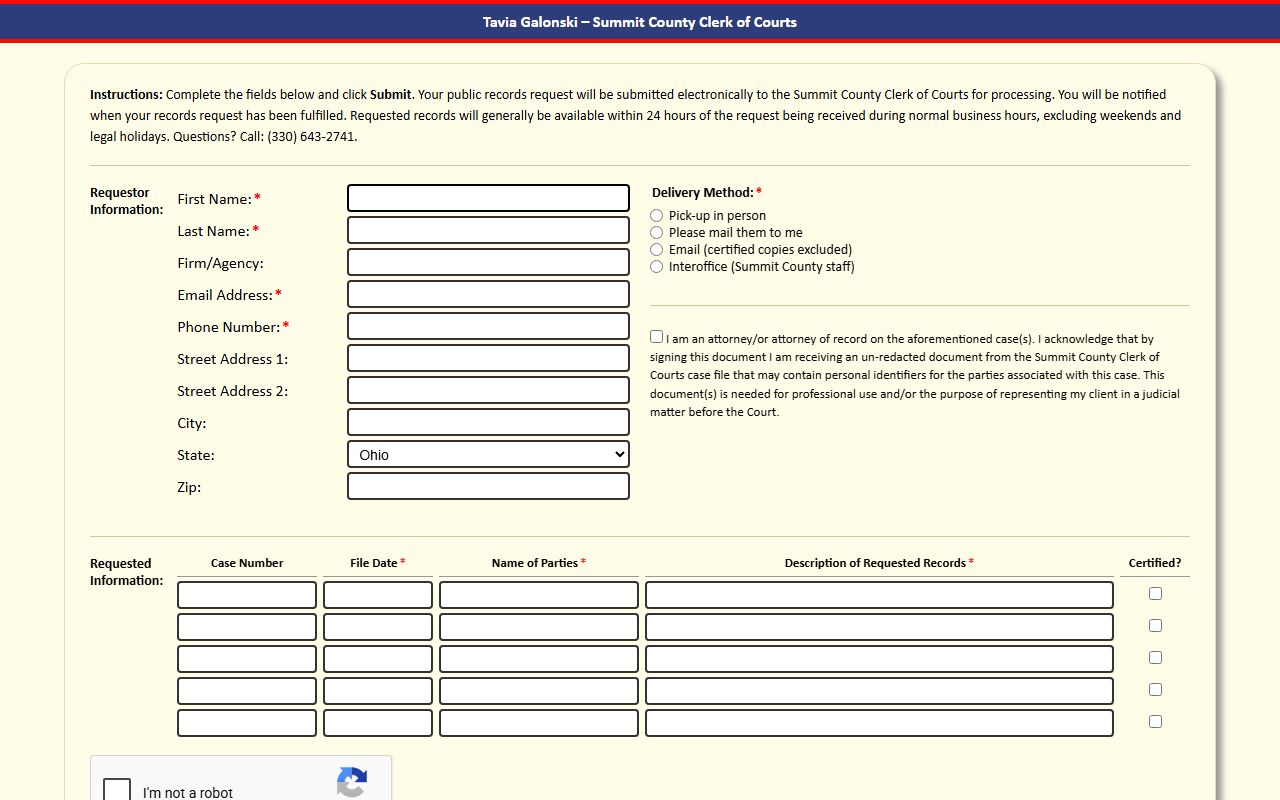
The table below lists the main fields on that form and what each one needs.
| Field | Required | Notes |
|---|---|---|
| First Name | Yes | Requestor first name. |
| Last Name | Yes | Requestor last name. |
| Email Address | Yes | Used to notify you; must be a valid email. |
| Phone Number | Yes | Required contact number. |
| Delivery Method | Yes | Pickup, mail, email (no certified copies), or interoffice for county staff. |
| Case Number | No | Case ID if you have it; speeds up the search. |
| File Date | Yes | Filing date in MM/DD/YYYY. |
| Name of Parties | Yes | The parties on the case. |
| Description of Records | Yes | What document you want. |
| Certified? | No | Check this to get a certified copy of that line. |
| reCAPTCHA | Yes | Google check to confirm you are not a bot. |
Address fields only become required when you pick mail delivery. There is also an attorney checkbox. An attorney of record can check it, add an Ohio Bar ID, and receive an unredacted document for use in a case. That is not a general public bypass. It is a controlled path for counsel.
Summit County Clerk Fees
Searching online is free. Copies are not. The Clerk publishes a copy fee schedule, and the rates are low for ordinary pages. Certified copies cost more because the office authenticates each one. The table below lists the public records copy fees the Clerk charges.
| Item | Amount |
|---|---|
| Copies (per page) | $0.10 |
| Computer docket printouts (per page) | $0.10 |
| Certified copies (per page) | $1.00 |
| Authentication / exemplification / triple seal | $5.00 |
| Special report requiring IT staff time | $25 per 15-minute increment |
The authentication, exemplification, or triple-seal fee comes up for official, out-of-state, or appellate use, when a plain certified copy is not enough. Remember that certified copies cannot be sent by email. Pickup or mail is the way to get them. And the office does not take online payments, so plan to pay through the Clerk directly.
Public Access Rules for Court Records
Court records in Ohio are open by default, but two sets of rules govern access. The Clerk applies the Supreme Court of Ohio Rules of Superintendence to court records. Cases that began before July 1, 2009, fall under Ohio's Public Records Act instead. The office still protects non-public details. That means Social Security numbers, bank numbers with security codes, and victim names and addresses in criminal cases are kept out of public view.
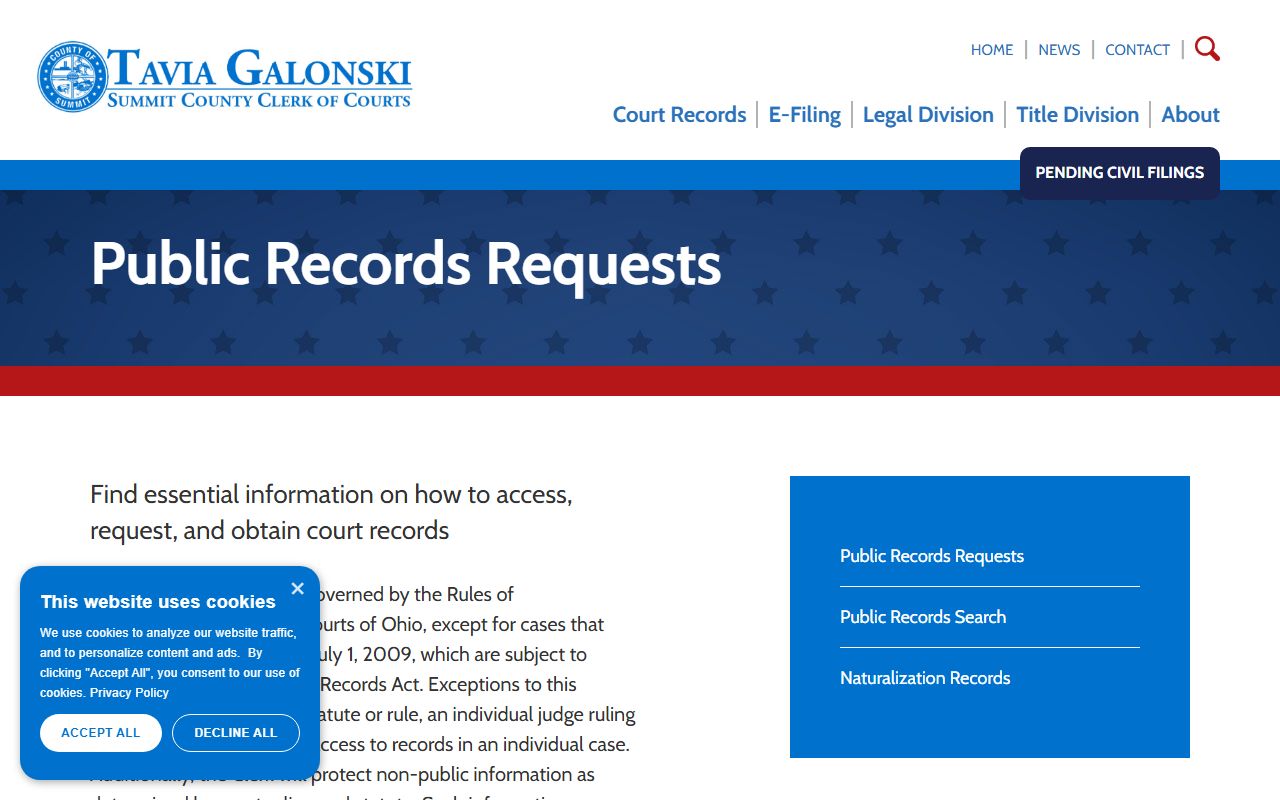
For records from 2002 to the present, the Clerk recommends the website for instant access. For records before 2002, you submit the public records form by email, mail, or in person. The image below shows the official Summit County Clerk of Courts public records request instructions.
The core statute behind public access is Ohio Rev. Code § 149.43, which defines public records, sets copy rules, and lets people enforce access in court. For court files, though, the court rules take the lead. When a record seems closed or heavily redacted, ask the Clerk division that holds it.
E-Filing and Online Records
The Clerk runs an e-filing system for the courts it serves. Attorneys and parties can file electronically at any hour, even when the counter is closed. The free public case search covers the Common Pleas General Division, the Domestic Relations Court, and the Ninth District Court of Appeals. The screenshot below shows the official Summit County Clerk of Courts civil case-number search.
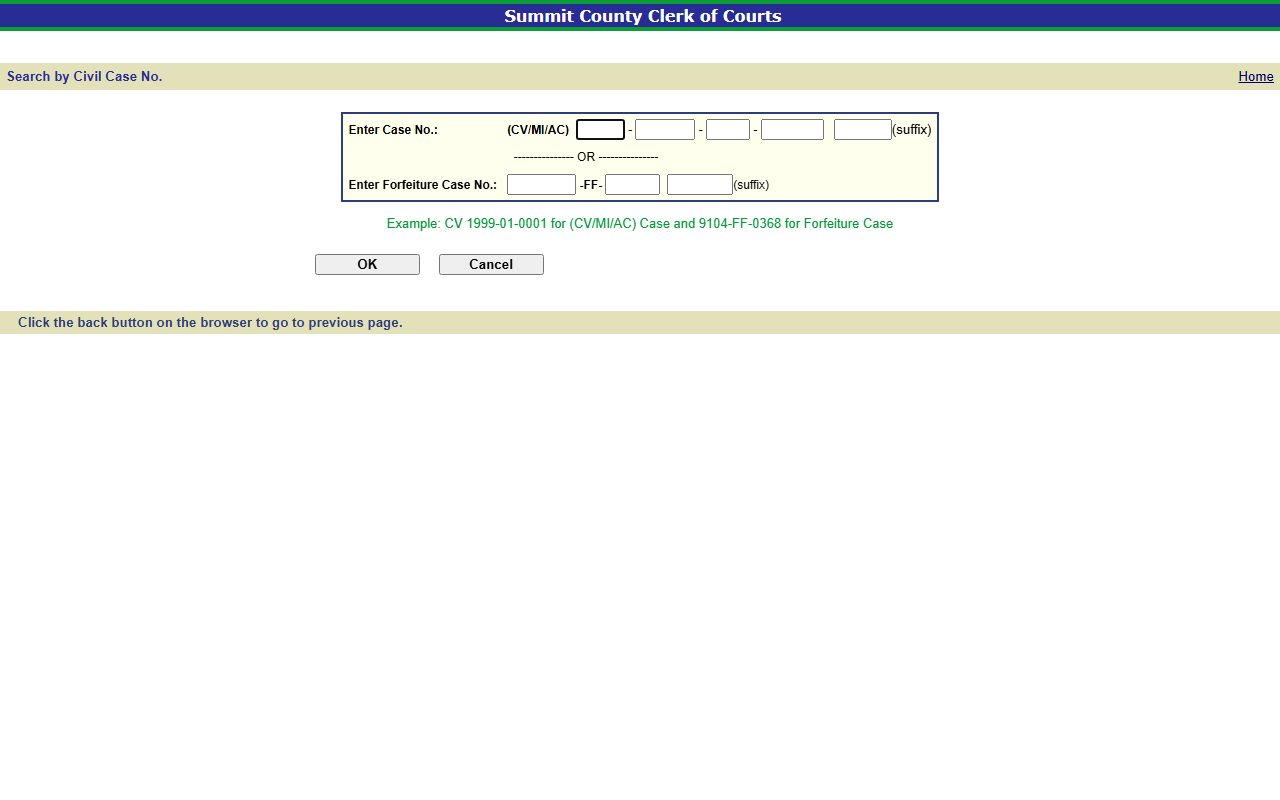
The case-number search splits the number into parts. A standard civil case uses a prefix, a four-digit year, a two-digit part, and a four-digit sequence. Forfeiture cases use a different format with a -FF- block. You can also search by name, by commercial name, or with a mixed search by judge, date, case type, and document type. For docket details on a case, see court dockets.