
The Summit County Court of Common Pleas
Ohio builds its trial courts around the Court of Common Pleas. The Ohio Constitution sets up one common pleas court in each county, so Summit County has its own. This is the court of general jurisdiction. It hears the big cases that municipal and mayor's courts cannot. Felony crimes, large civil suits, foreclosures, and appeals from state agencies all land here.
What makes Ohio different is the division model. The state does not number its trial courts the way some states do. There is no "5th District Court" or "250th Court" in Summit County. Instead, the single Court of Common Pleas splits into four divisions by subject. The General Division takes felonies and major civil work. Domestic Relations takes divorce and family law. Juvenile Court takes youth cases. Probate takes estates and marriage licenses. Each division keeps its own records, and that is the first thing to know before any search.
The court's authority comes straight from the state's founding document. Ohio Constitution Article IV, Section 4 creates the courts of common pleas and their divisions, including probate. The General Division alone runs with ten judges and hears more than 1,600 cases a year, by a 2026 county performance audit.
Summit County Common Pleas Courts and Offices
The county's trial-court system reaches across several buildings in Akron and a few of the bigger municipalities. The General Division and Probate share the historic courthouse on South High Street. Domestic Relations works from the courthouse annex next door, and Juvenile Court runs from its own building on Dan Street. Below them, the municipal courts handle the everyday docket. The table lists the courts, where they sit, how to reach them, and what they hear.
| Court | Address | Phone | Jurisdiction |
|---|---|---|---|
| Common Pleas, General Division | 209 S. High Street, Akron, OH 44308 | 330-643-2162 | Felony criminal, major civil, foreclosure, administrative appeals, probation, ADR |
| Domestic Relations Court | 205 S. High Street, Akron, OH 44308 | 330-643-2365 | Divorce, dissolution, annulment, custody, support, protection orders |
| Juvenile Court | 650 Dan Street, Akron, OH 44310 | 330-643-2900 | Delinquency, dependency, abuse and neglect, juvenile traffic |
| Probate Court | 209 S. High Street, Akron, OH 44308 | 330-643-2900 (court line) | Estates, guardianships, adoptions, marriage licenses, name changes |
| Akron Municipal Court | 172 S. Broadway, Akron, OH | 330-375-2120 | Misdemeanor, traffic, small claims, civil, preliminary felony |
| Barberton Municipal Court | 576 W. Park Ave., Barberton, OH 44203 | 330-753-2261 | Misdemeanor, traffic, small claims, civil |
| Stow Municipal Court | 4400 Courthouse Dr., Stow, OH 44224 | 330-564-4200 | Misdemeanor, traffic, small claims, civil |
| Ninth District Court of Appeals | Akron, OH (serves Summit County) | See court site | Intermediate appeals from Summit County trial courts |
Note: phone numbers route to general court lines, so confirm the right division extension before you call about a specific case file.
The General Division
The General Division is the workhorse of the Court of Common Pleas. It hears felony criminal cases, the State of Ohio versus the defendant. It hears major civil suits, the kind that run past the dollar limits of a municipal court. It handles foreclosures, which spike in hard years. It reviews appeals from state and local agencies, and it runs probation and the court's alternative dispute resolution program. The Common Pleas General Division publishes its judges, programs, and case-search link on its own site.
Ten judges sit on the General Division bench. The court hears more than 1,600 cases a year, a heavy load for any trial court. Each judge keeps a docket, and the assigned judge appears on most case records. When you search a General Division case, the file shows the judge, the case type, and a running list of filings. The clerk keeps those files, not the judges. To pull a record, you go through the Clerk of Courts, who runs the public case index.
This is the division most people mean when they say "the courthouse." Its felony and big-money civil work feeds most of the county's serious court records.
The Domestic Relations Division
Domestic Relations is the family side of the Court of Common Pleas. It has sole power over divorce, dissolution, and annulment in the county. It also handles legal separation, custody, parenting time, child and spousal support, and many protection-order matters. When children are involved, the court keeps ongoing power over the case, so a file can stay active for years. The Domestic Relations Court sets out its jurisdiction, hours, and floor layout on its own site.
The image below comes from that official Domestic Relations site.
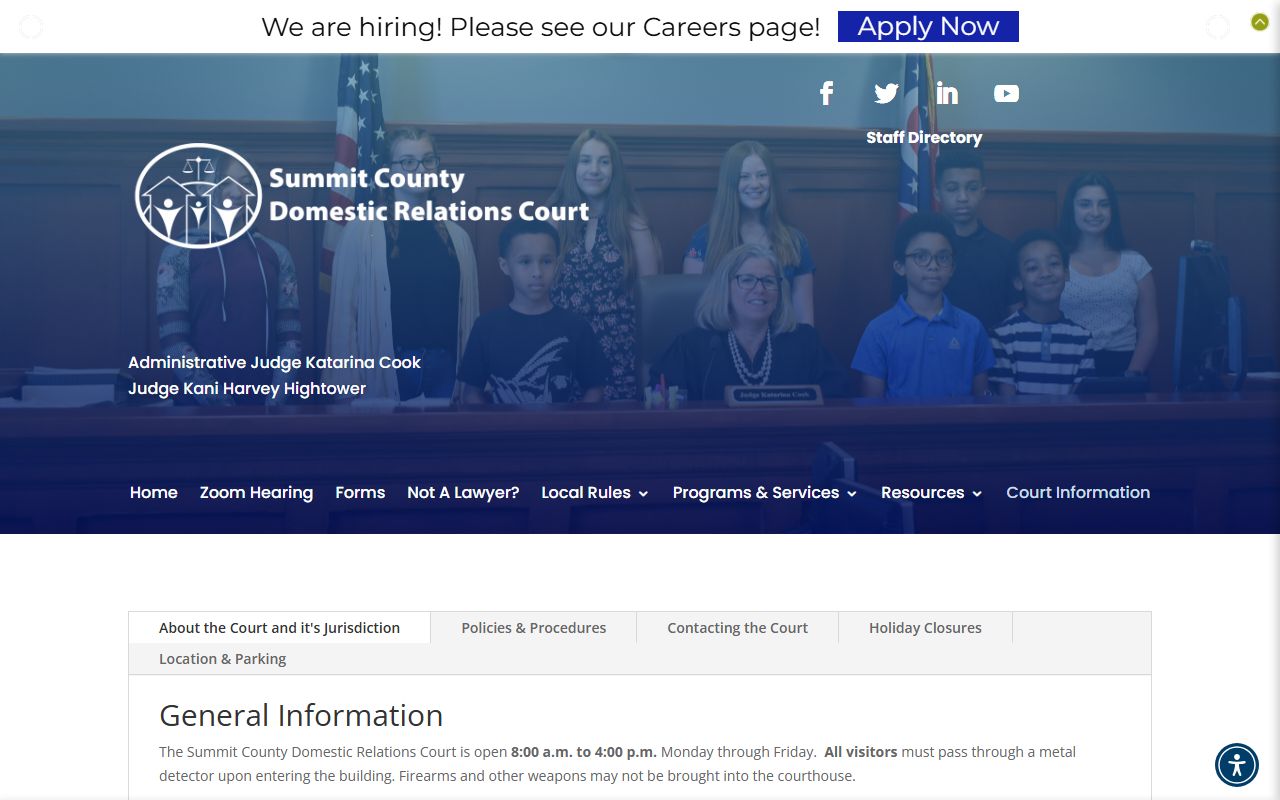
The court works from the courthouse annex at 205 South High Street, the same address as the Clerk Legal Division. Magistrate hearings usually sit on the third floor. Judge hearings sit on the fourth. The assignment office and Family Court Services work from the second floor. All visitors pass through a metal detector at the door, and weapons are not allowed.
Many people in family court do not have a lawyer. The court posts checklists and forms for them. The next image shows that self-help page.
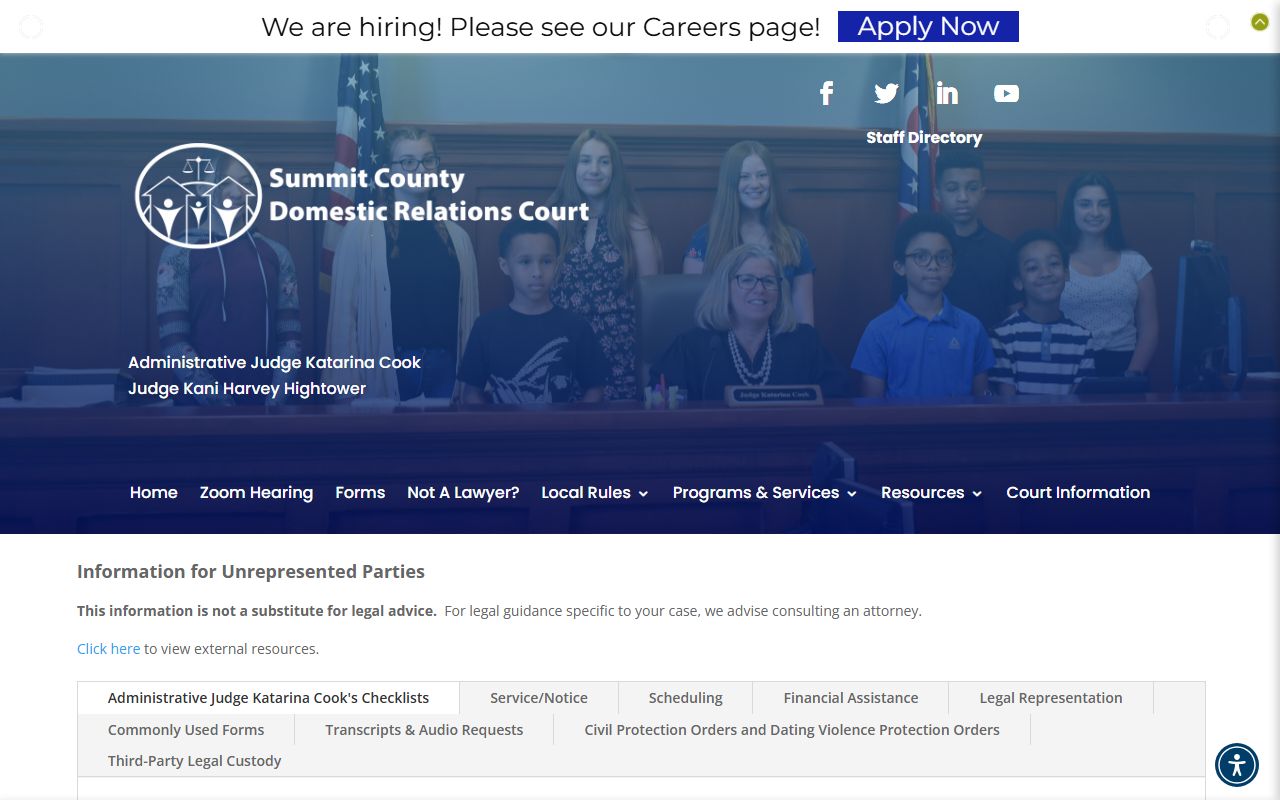
For the records side of family cases, see marriage and divorce records. The Clerk Legal Division keeps the Domestic Relations case files.
The Juvenile Division
Juvenile Court handles cases that involve children and youth. That covers delinquency, the juvenile version of a crime. It covers dependency, abuse, and neglect, where the question is a child's safety. It covers juvenile traffic and certain custody matters tied to children. The court runs its own detention center, open every hour of every day. The Juvenile Court describes its reform work and its certified specialized dockets on its site.
The screenshot below is from that official Juvenile Court page.
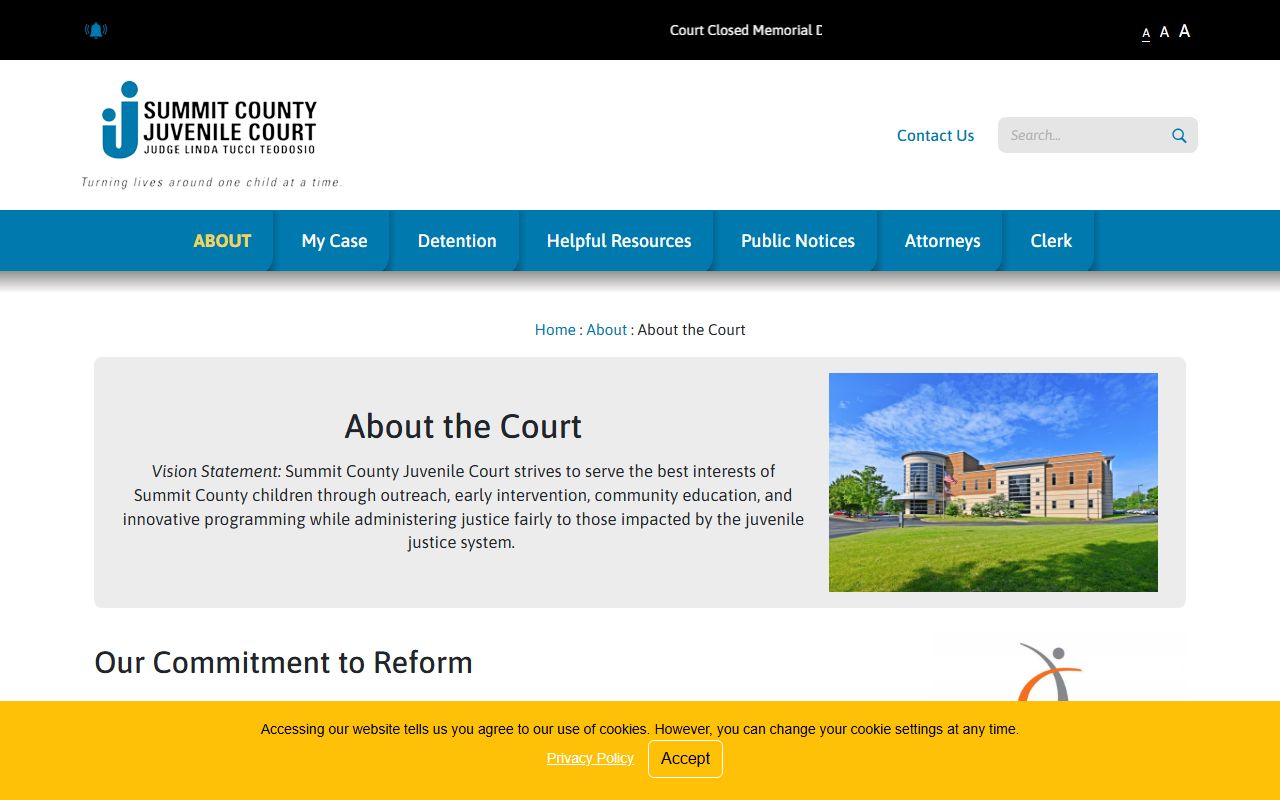
Juvenile records are not open like adult court files. Ohio law restricts them, and most reach only the parties, their lawyers, certain agencies, or someone with a court order. So you will not find a juvenile case through the clerk's public search the way you find a felony. The court describes Summit County as one of three Ohio counties pushing reform into the deep end of juvenile justice. In March 2026, one of its specialized dockets earned state recertification.
The Probate Division
Probate is the fourth division of the Court of Common Pleas. It handles estates, wills, and trusts. It appoints guardians for people who cannot manage their own affairs. It approves adoptions and grants name changes. And in Ohio, the probate court is where marriage licenses come from, not a vital records office. Probate also handles certain mental-health proceedings. The Probate Court keeps its own eServices search portal, apart from the clerk's civil and criminal index.
Because probate runs its own records system, a probate search starts in a different place than a felony or civil search. The estate of a person who died in the county, a guardianship over an elderly parent, or an old marriage license all live in probate, not in the Clerk Legal Division. For more on those files, see probate records.
Common Pleas vs. Municipal Court vs. Mayor's Court
Below the Court of Common Pleas sit the lower courts. These are courts of limited jurisdiction. They cannot hear a felony trial or a big civil suit, but they handle the high volume of small cases. Municipal courts take misdemeanors, traffic, small claims, and civil cases within set money limits. Mayor's courts, where a city keeps one, handle local ordinance and traffic matters. The table sets the three side by side.
| Court of Common Pleas | Municipal Court | Mayor's Court | |
|---|---|---|---|
| Jurisdiction | General trial court | Limited jurisdiction | Local ordinance only |
| Case Types | Felony, major civil, divorce, estates, juvenile | Misdemeanor, traffic, small claims, civil, preliminary felony | Local ordinance, minor traffic |
| Money Limit / Level | No civil cap; felony-level | Civil cap set by statute; misdemeanor-level | Fines for local violations |
| Court of Record? | Yes | Yes | No |
The money limit on municipal civil cases is fixed by state law. Ohio Rev. Code Section 1901.17 sets that civil jurisdiction. A mayor's court is not a court of record, so a case there can move up to a municipal court for a fresh hearing if a person asks. A felony preliminary hearing often begins in a municipal court, then transfers to the General Division of Common Pleas for the rest of the case.
How a Case Moves Through the System
Most serious cases climb the ladder of courts. A felony often starts in a municipal court for a first appearance and a preliminary hearing. From there it moves up to the General Division of Common Pleas, where the trial and sentence happen. A losing side can appeal to the Ninth District. The Supreme Court of Ohio sits at the top, though it takes most cases only at its own choice. The line below shows the usual path.
Case flow: Municipal Court › Common Pleas General Division › Ninth District Court of Appeals › Supreme Court of Ohio
Not every case follows the full path. A small claims case may end in municipal court and go no further. A divorce begins and ends in Domestic Relations unless someone appeals. The point is the direction. Records pile up at each step, so the same dispute can leave files in two or three courts. To read the day-by-day events of a case, check the court dockets. To pull the full case file, start with court records.
The Ninth District Court of Appeals
Appeals from Summit County trial courts go to the Ninth District Court of Appeals. This is an intermediate court. It does not hold a new trial. Instead, it reviews the record from below and decides whether the trial court got the law right. The Clerk Legal Division keeps Ninth District filings made through its office, along with General Division and Domestic Relations records.
Above the Ninth District sits the Supreme Court of Ohio. It is the court of last resort. It takes most appeals only when it agrees to, and it also writes the rules that govern how courts handle their records. Those Rules of Superintendence, not the general public records law, control access to most modern court files in the county.
Specialty Courts in Summit County
The Court of Common Pleas runs several problem-solving dockets. These pair court supervision with treatment instead of punishment alone. The official specialty courts page lists the Turning Point Program, the Domestic Violence Court, Reentry Court, Valor Court, and HOPE Court. Valor Court is the county's veterans treatment court. It blends judicial review, treatment planning, and veteran-specific services for defendants whose service and charges overlap.
A few of these dockets are worth a quick word:
- Valor Court serves veterans with treatment needs tied to their criminal charges.
- Domestic Violence Intervention Court focuses on accountability and treatment, with attention to prior victimization and mental health.
- HOPE Court is the mental-health treatment docket, pairing supervision with behavioral-health care.
- Reentry Court helps people returning from prison meet supervision, treatment, and work goals.
Juvenile Court runs its own certified specialized dockets and highlights reform work such as JDAI and Deep End Reform. Records from these dockets follow the same access rules as the division that holds them, so a Valor Court file sits with the General Division and a juvenile docket stays restricted.
Courthouse Location and Hours
The General Division and the Probate Court share the historic Summit County Courthouse in downtown Akron. The Clerk Legal Division and Domestic Relations Court use the annex next door. Juvenile Court runs from its own building a short drive away. Hours and entrances vary by office, so confirm before a visit. The contact card below covers the main courthouse for General Division matters.
Common Pleas, General Division
209 S. High Street
Akron, OH 44308
330-643-2162
Mon-Fri 8:00 a.m.-4:00 p.m.
Visitors pass through a metal detector at entry, and weapons are not allowed inside. The courthouse sits near South High Street and University Avenue, close to the Akron Municipal Court and county buildings. A parking deck connects to the courthouse by skywalk. The county was set up in 1840, and the name "Summit" reflects the high point of the old Ohio and Erie Canal, with Akron as the county seat and legal center ever since.