
What Probate Covers in Summit County
Probate is the part of the court that deals with people's estates and their care. In Summit County it is a division of the Court of Common Pleas, known as the Probate Division or simply the Summit County Probate Court. It is a current, working court, not just an archive of old wills. The division handles wills and estates, guardianships, conservatorships and trust matters, adoptions, name changes, marriage licenses, mental-health and civil commitment cases, and minor settlements. That is a wide mix of records, and not all of them are open to the public.
The split matters because probate is separate from the rest of the court system. Civil and criminal Common Pleas cases run through the Clerk of Courts. Divorce and family files run through the Domestic Relations Court. Estates, guardianships, and marriage licenses run through Probate. So a search for a will or an estate starts in a different place than a search for a lawsuit or a divorce. Knowing the record type points you to the right office and saves time.
One key Ohio rule sits at the center of probate. The probate court issues marriage licenses, and it admits wills to probate after a person dies. For the family side of records, see marriage and divorce records.
Probate Terms Defined
Probate paperwork uses words that do not come up much in daily life. A few short terms cover most of what you will read in an estate or guardianship file. Knowing them makes a case docket much easier to follow.
- Testator
- The person who made the will. Under Ohio law, a testator is any person who makes a will.
- Executor
- The person named in a will to carry it out and settle the estate.
- Intestate
- Dying without a valid will. The estate is then split under Ohio intestacy law.
- Fiduciary
- A person the court trusts to act for an estate or ward, such as an executor, administrator, or guardian.
- Letters of authority
- The court paper that proves a fiduciary has the legal power to act for an estate.
- Guardianship
- A court appointment that lets one person make decisions for an adult or minor who cannot.
Note: a conservatorship is a related arrangement, often voluntary, where the court helps protect a person's money or property.
How to Search Summit County Probate Records
The Probate Court runs its own search tool, called eServices. It is not part of the clerk's civil and criminal case search, so you have to go to the probate site to use it. The portal loads through a session-based system, and the public access page sets out clear rules for how a search works. The screenshot below comes from the Summit County Probate Court eServices portal.
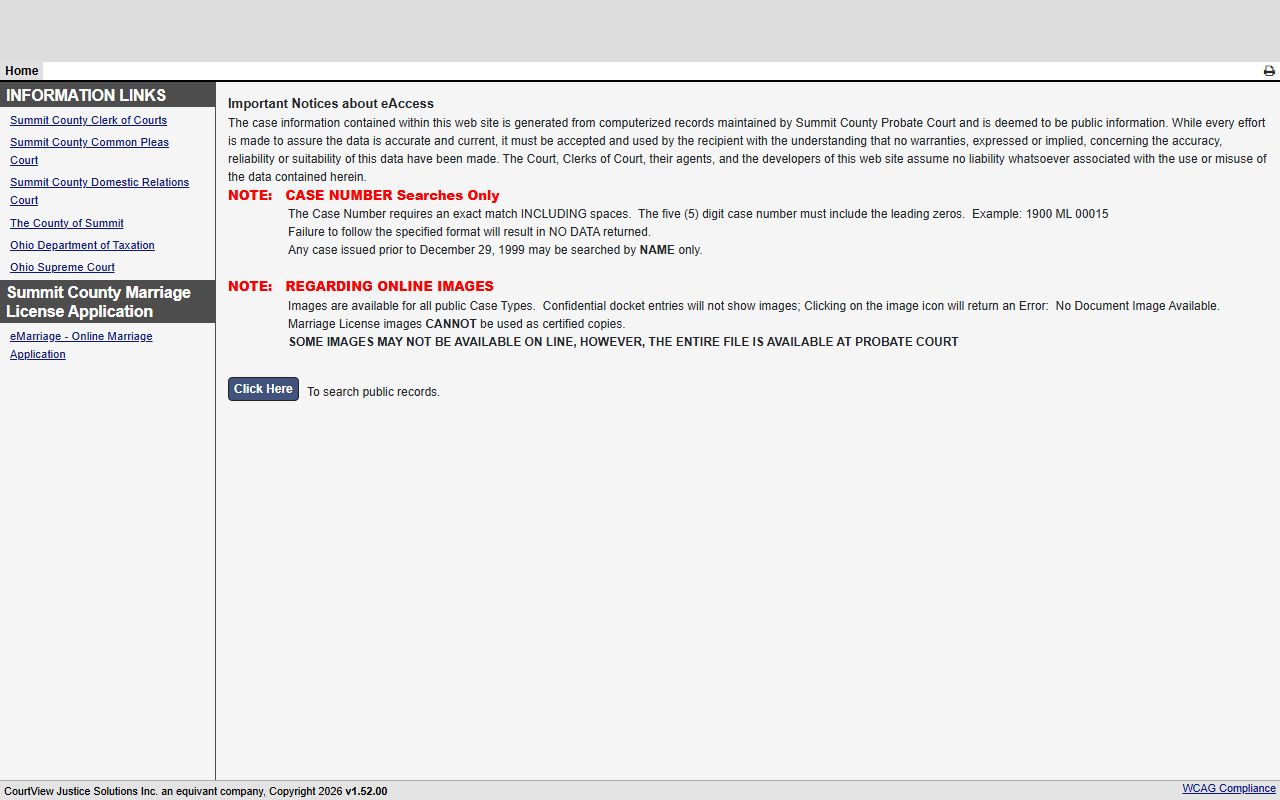
That landing page gives a few useful facts. Case-number searches need an exact match, and the five-digit case number must keep its leading zeros. Any case issued before late December 1999 can be searched by name only. Images are offered for public case types, but confidential docket entries will not show an image, and a marriage license image cannot serve as a certified copy. Some images may not be online even when the full file exists at the court. The exact field labels live inside the live portal, so check them there as you search. The steps below outline the basic flow.
- Open the official Probate eServices portal and read the access notice before you start.
- Pick how you want to search. You can look up a case by name or by an exact case number, depending on the case age and type.
- Enter your terms. For an exact case number, keep the leading zeros and the spacing the system expects.
- Open a matching case to view its docket. Some documents show as images; confidential entries will not.
- For anything not online, or for a certified copy, contact the Probate Court records staff in Akron.
The portal is a starting point, not the whole file. If a record does not appear, the full case may still exist at the courthouse counter.
Probate Courts in Summit County
Summit County has one probate court for the whole county. It is the Probate Division of the Court of Common Pleas, located in downtown Akron at the main courthouse address on South High Street. The same office issues marriage licenses, opens estates, and handles guardianship and adoption work. Because there is just one probate venue, every estate or guardianship filing for a Summit County matter routes to this court. The contact card below gives the address and the official site.
Summit County Probate Court
209 S. High Street
Akron, OH 44308
Probate Division, Court of Common Pleas
The Probate Court shares the courthouse complex with the General Division of the Court of Common Pleas. While the two divisions sit close together, they keep separate records and separate counters. Confirm office hours on the probate site before a visit, since each court in the complex can open at different times.
What Summit County Probate Records Show
A probate file is built around a case number and the events that follow it. An estate case grows over time as the fiduciary files papers, gives notice, and reports to the court. The file usually opens with an application and, if there is a will, the will itself once it is admitted. From there it gathers the fiduciary bond or waiver, the letters of authority, an inventory of assets, notices to heirs and creditors, accountings, receipts, distributions, and the final orders that close the estate.
Guardianship files follow their own track. They tend to include the application, any medical or expert evidence of incapacity, hearing notices, the order that appoints the guardian, and then ongoing inventories, accountings, and reports. The two-column table below sums up the common parts of a Summit County probate file and what each part tells you. It describes the kinds of documents a public case holds; it is not a fee list.
| Document | What It Shows |
|---|---|
| Application | The request to open an estate, guardianship, or other probate matter. |
| Will (if any) | The decedent's will once the court admits it to probate. |
| Letters of authority | Proof that the fiduciary may act for the estate or ward. |
| Inventory | A list of the estate's assets or the ward's property. |
| Notices | Notices to heirs, next of kin, and creditors. |
| Accountings | Reports of money taken in, paid out, and held. |
| Final orders | The entries that approve distribution and close the case. |
A probate docket also lists the case type, the filing date, the names of the decedent or protected person, the fiduciary, the attorney, and the judge or magistrate. Hearing dates and due dates for inventories and accounts often appear as well.
How Probate Works in Summit County
Probate follows a set path, though the exact steps depend on the case type. If a person dies with a will, the court admits the will and appoints a fiduciary to carry it out. If there is no will, the estate is administered under Ohio intestacy law, which sets who inherits. Smaller estates may not need full administration at all. Ohio allows a release from administration under Ohio Rev. Code § 2113.03 when the estate meets the statute's conditions. That shorter route still needs a probate filing and court approval. The numbered list below walks through the general flow.
- Identify the case type: estate with a will, estate without a will, release from administration, guardianship, adoption, name change, marriage license, or a mental-health matter.
- Search the Probate eServices index for any existing case or related filing.
- Use the court's official probate forms and follow its local rules.
- File the case at the Probate Court on South High Street in Akron.
- Give notice to the parties the law requires, such as heirs or next of kin.
- Attend a hearing if the court sets one.
- File the inventories, accounts, reports, or closing papers the court orders.
- Request certified copies or letters of authority from the records staff when you need them.
The definition of a will sits in Ohio Rev. Code § 2107.01, which explains what counts as a will and names the testator as the person who makes one. The image below is that statute on the official state code site.
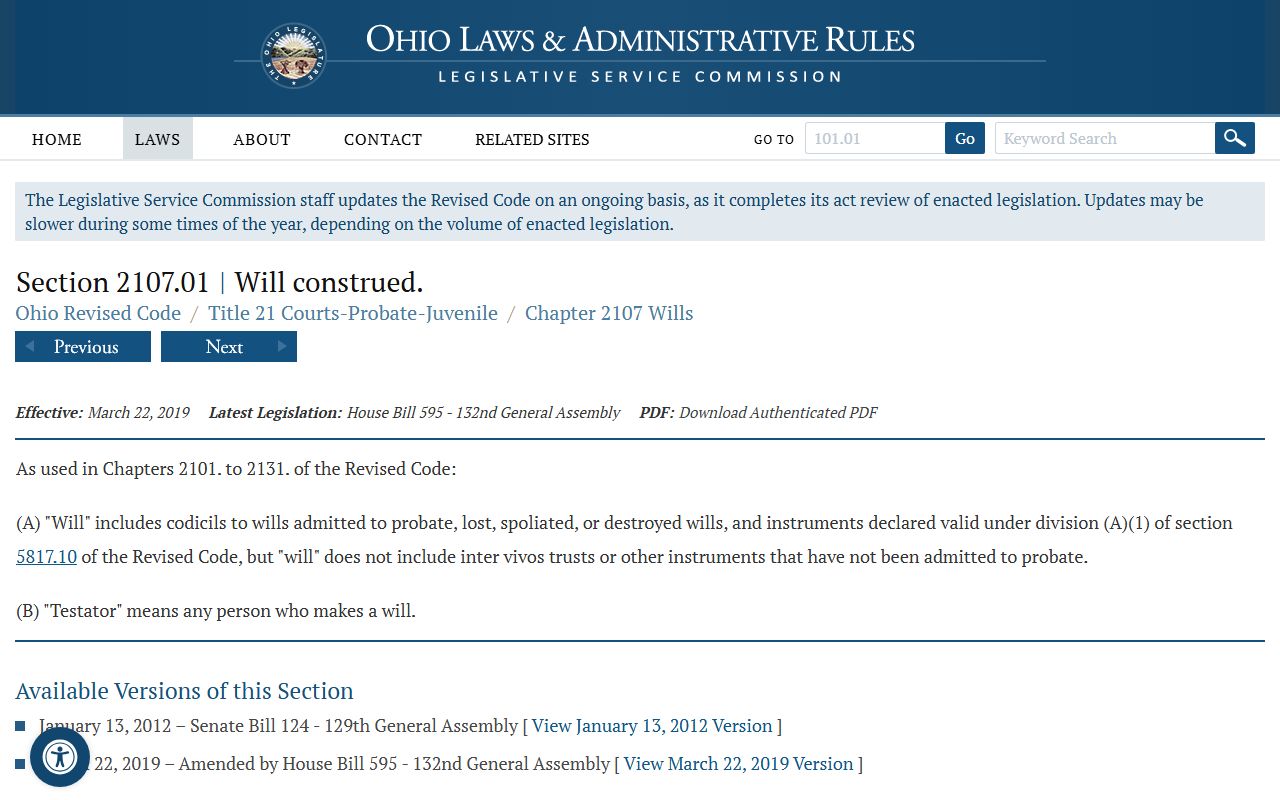
These statutes set the frame, but the local Probate Court handles the actual filing, hearing, and recording for Summit County cases.
Marriage Licenses Through Probate
In Ohio, the probate court is the office that issues marriage licenses. Summit County is no different. Couples apply at the Probate Court, and the license becomes a probate record once it is issued. The state statute sets the venue rules. Under Ohio Rev. Code § 3101.05, an Ohio resident applies in the county where either person lives. If neither person lives in Ohio, the couple applies in the county where the marriage will take place. The image below shows that statute on the official state site.
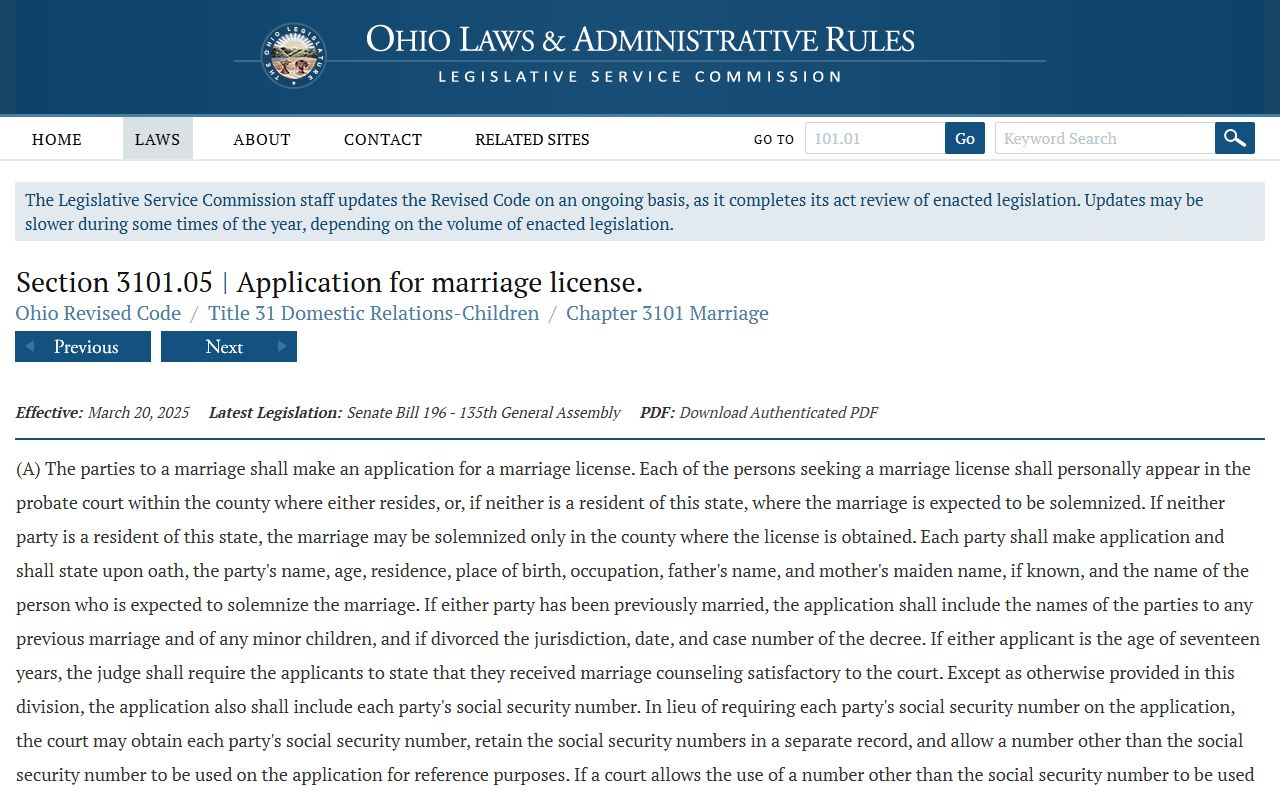
The statute also lists what an application must include, such as each person's name, age, and place of birth, plus details about any prior marriage. Both applicants usually appear in person and present identification. After the ceremony, the officiant returns the signed license for recording. The Probate eServices notice warns that a marriage license image from the online portal cannot be used as a certified copy. For an official copy, order it from the court. Confirm current fees and any current rules with Probate before you apply.
Probate Fees and Copy Costs
Probate charges fees to open a case, issue a license, and supply certified copies. The amounts change over time and are set by the court, so the safe move is to confirm them on the official Probate fee page before you file or order anything. Current Summit County probate dollar amounts are not published here on purpose, because they should come straight from the court.
Note: Always confirm current probate filing, license, and certified-copy fees on the official Summit County Probate Court site before you file a case or order a record.
Court copy fees can vary by office. The Summit County Clerk of Courts, which is a separate office from Probate, lists its own court-record copy fees: ordinary copies at $0.10 per page, certified copies at $1.00 per page, and authentication or triple seal at $5.00. Those rates belong to the Clerk, not to Probate, so do not assume the Probate Court charges the same. For clerk-side copy details, see the Clerk of Courts page.
Restricted Probate Records
Not every probate file is open to the public. Two case types are confidential by their nature. Adoption files are sealed, and mental-health or civil commitment files are restricted. These records protect deeply private matters, so a normal eServices search will not show them, and the court controls who may see them. Minor guardianship and minor settlement files can also carry protections, since they involve children.
Even in public cases, the court can hold back certain details. Confidential docket entries will not display a document image online, as the eServices notice points out. If you think a probate record exists but you cannot reach it, the path depends on the case. For a sealed adoption or a mental-health file, only the court can grant access, and only on proper legal grounds. For a public case where a document is not online, the full file may still be available at the courthouse counter. When in doubt, ask the Probate Court records staff. For the broader rules on what is open and what is closed, see court records.