
How to Search Summit County Traffic Court Records
The way to find a Summit County traffic record depends on the court that holds the case. Adult traffic cases are not kept in one shared database. They sit with the municipal court for the place of the violation. So the first thing to do is read the ticket. It names the court, the case or citation number, and a date. That court is where the record lives, and its own clerk is the office that can answer questions about your case.
Before you start, pull together a few details. A citation number helps most. A driver name and a date of birth help too. The hearing date on the ticket can also narrow a search. Each court runs its own counter and its own phone line, and online tools vary from one to the next. The safest path is to confirm what the named court offers rather than assume one shared portal exists.
- Read the ticket and find the court named on it, such as Akron, Barberton, or Stow Municipal Court.
- Gather your citation number, driver name, and date of birth before you search or call.
- Contact the named court by its own clerk line or website to ask how it handles record lookups.
- Give the citation number first; use the name and date of birth only if the number does not work.
- Review the case details and disposition, then ask the court clerk for a certified copy if you need one.
If you are not sure which court got the ticket, the law-enforcement agency on the citation is a clue. City police often route to the city's municipal court. A county or state stop may go elsewhere. When in doubt, call the court printed on the ticket and let its staff point you to the right file.
Which Courts Handle Traffic Cases in Summit County
Ohio splits traffic work between several courts. Municipal courts have limited jurisdiction over misdemeanors, traffic, small claims, and the early stages of felony cases. In Summit County, three municipal courts handle most adult traffic tickets. Which one depends on where the stop happened. Akron-area tickets often go to Akron Municipal Court. Barberton and Norton-area tickets may go to Barberton Municipal Court. Northern communities may route to Stow Municipal Court. The court named on your ticket is the one that controls.
Two other paths matter. Juvenile traffic does not go to a municipal court. It goes to the Summit County Juvenile Court, which lists a Cashier and Traffic line at 330-643-2977. And a serious or repeat OVI can be charged as a felony, which moves the case to the Court of Common Pleas. Ohio Revised Code section 1901.17 sets the civil jurisdiction limits for municipal courts.
| Court | Traffic Cases Handled | Address |
|---|---|---|
| Akron Municipal Court | Adult misdemeanor and traffic cases in the Akron area | 172 S. Broadway, Akron, OH |
| Barberton Municipal Court | Adult traffic and misdemeanor cases within Barberton jurisdiction | 576 W. Park Ave., Barberton, OH 44203 |
| Stow Municipal Court | Adult traffic and misdemeanor cases for northern-area communities | 4400 Courthouse Dr., Stow, OH 44224 |
Note: always check the court named on your ticket, since the place of the stop, not your home address, decides which court hears the case.
Types of Traffic Cases on Record
Traffic records cover more than a speeding ticket. They run from minor non-moving violations to serious criminal traffic charges. Most fall under a state statute or a local ordinance. The charge type shapes how the case moves and what shows up in the file. A few common groups appear again and again across the municipal courts.
- Moving violations cover speeding, running a red light, unsafe lane changes, and failure to yield.
- Non-moving and equipment violations cover things like broken lights, expired plates, or no proof of insurance.
- Parking citations are usually the lowest-level matters and may be handled separately by the city.
- Commercial vehicle and CDL violations carry their own rules and stricter reporting for drivers who hold a commercial license.
- Criminal traffic charges such as OVI or driving under suspension can carry jail time and may move beyond municipal court.
Many minor traffic stops use a citation in lieu of arrest. Ohio Revised Code section 2935.26 lets an officer issue a citation for a minor misdemeanor instead of taking the person into custody. That citation is the document that opens the court case. The more serious the charge, the more likely an arrest and a fuller court file.
What Summit County Traffic Court Records Show
A traffic court record is built from the citation plus the events that follow it. The exact fields differ by court, but the core data is consistent across traffic cases. Some fields are simple, like the violation date. Others, like the disposition, decide the whole case. The table below lists the fields a Summit County traffic court file may show.
| Field | What It Shows |
|---|---|
| Citation / Ticket Number | The unique number for the ticket, printed on the citation and used to find the case. |
| Driver Name | The name of the person charged with the violation. |
| Violation Date | The date the stop or alleged offense happened. |
| Law-Enforcement Agency | The police or patrol agency that issued the citation. |
| Statute / Ordinance | The state code section or local ordinance the charge is based on. |
| Charge Description | A plain description of the violation, such as speed or right-of-way. |
| Court Date | The scheduled hearing or appearance date. |
| Plea | How the driver answered the charge: guilty, not guilty, or no contest. |
| Disposition | The outcome, such as a finding, a plea result, or a dismissal. |
| Fine / Costs | The money owed, including the fine and court costs. |
| Payment Status | Whether the balance is paid, partly paid, or still due. |
| Warrant / FTA Status | A failure-to-appear flag or warrant note if the driver missed a date. |
| License / Points Note | License or points consequences if the court reports them. |
Not every record shows every field. Courts redact some personal data, and the points side of a case is often tracked by the state rather than the court. A traffic file is the court's view of the case, not a full driving history.
Searching by Citation Number vs by Name
There are two common ways to look up a traffic case. One uses the citation number. The other uses the driver name. Each has strengths. The citation number points to one exact case, so it is the cleanest method when you have the ticket in hand. A name search casts a wider net, which helps when the ticket is lost but can return several people with the same or similar names.
Because the municipal court portals were not inspected for this page, the table below is a general guide, not a list of exact field labels from any one court. Confirm the real search fields with the court named on your ticket before you rely on them.
| Search Method | Best When | Watch Out For |
|---|---|---|
| Citation / ticket number | You have the ticket and want one exact case | Format and leading zeros must match the court's system |
| Driver name | The ticket is lost or you are checking a history | Common names return many matches; try spelling variations |
| Name plus date of birth | A name search returns too many results | Not every court accepts a date of birth as a filter |
When a citation number search fails, check for typos and try the name. When a name search floods you with results, add a date of birth or a violation date if the court allows it. If neither works, the court clerk can look up the case for you with a name and a date.
Paying or Contesting a Summit County Traffic Ticket
A ticket gives you a choice. You can pay it, which usually counts as a plea and ends the case, or you can contest it in court. The deadline and the methods depend on the municipal court that holds the case. Many courts take payment online, by mail, or at the counter, but the rules differ. Read the ticket and the court's instructions, and do not miss the date. Missing a court date can trigger a failure-to-appear and even a warrant.
If you want to fight the charge, you enter a not-guilty plea and set a hearing. A no-contest plea means you do not dispute the facts but ask the court to weigh them. A guilty plea or a paid waiver closes the case. The steps below outline the general path. Confirm the exact process with your court, since payment portals and appearance rules vary from one municipal court to the next.
- Read the ticket for the court name, the case number, the amount, and the deadline to respond.
- Decide whether to pay the ticket or contest it in front of the court.
- To pay, use the court's own payment method by the deadline and keep your receipt.
- To contest, enter a not-guilty plea with the court and ask for a hearing date.
- Appear on the set date, present your side, and follow any order the court issues.
Note: do not enter card details on any site that is not the official court, since the court named on your ticket is the only proper place to pay.
Public Access Laws for Traffic Court Records
Traffic court records are court records, so they follow Ohio's open-records framework. Court files in Ohio are governed by both the Ohio Public Records Act and the Supreme Court of Ohio Rules of Superintendence. The default is public access. Any person can ask to inspect or copy a court record, subject to redaction of protected data and a few closed categories. Juvenile traffic files are an exception, since juvenile records are more restricted than adult court records.
Key Statutes:
Ohio Rev. Code § 149.43 is the core public records statute. It defines public records, sets copy rules, and gives any person the right to inspect and copy them.
Ohio Rev. Code § 1901.17 sets the civil jurisdiction of municipal courts, the courts that hear most Summit County traffic cases.
For broader public-records help, the Summit County public records page explains how the Sunshine Laws work and how to file a request. For full case files, though, start with the court that holds the traffic case.
Court Traffic Records vs State Driver Records
This is the distinction that trips up most people. The court traffic record and the state driver record are two different files kept by two different agencies. The court record is the case: the citation, the filings, the plea, the fine and costs, and the disposition. The state driver record is the license history: status, points, and suspensions, kept by the Ohio Bureau of Motor Vehicles. One is held by a court. The other is held by the state. You may need to check both.
| Compare | Court Traffic Record | State Driver Record |
|---|---|---|
| Record source | The municipal court that hears the case | The Ohio Bureau of Motor Vehicles |
| What is in it | Citation, filings, plea, fine and costs, disposition | License status, conviction history, points, suspensions |
| Where to access | The court named on the ticket, by its own clerk | The Ohio BMV driver-record service |
| How to correct errors | Ask the court clerk that holds the case file | Contact the Ohio BMV about the driving record |
Why does this matter? A case can be closed at the court while the points still sit on the BMV record, or the other way around. If your concern is the case itself, go to the court. If your concern is your license or insurance, go to the BMV. The two files are linked in effect but stored apart.
CDL and Commercial Driver Records
Commercial drivers face stricter rules. A CDL holder is held to a higher standard, and many traffic options open to regular drivers are limited for them. Federal rules require certain convictions to be reported, and they flow to the driver's commercial record. A violation that seems minor for a personal license can carry real weight for a CDL. That is why many commercial drivers treat even a small ticket as a matter worth contesting.
The court that hears a commercial traffic case is still the municipal court for the place of the stop, unless the charge rises to a felony. But the consequences reach further. A conviction can affect the commercial driving record kept by the state and reported under federal commercial-driver rules. If you hold a CDL, confirm with the court and the Ohio BMV how a charge will be recorded before you decide how to plead.
DUI/OVI Cases
In Ohio, impaired driving is charged as OVI, operating a vehicle under the influence. A first OVI often starts in municipal court as a criminal traffic case. But a serious or repeat OVI can be charged as a felony, and a felony OVI moves to the Court of Common Pleas. These are criminal matters, not simple traffic tickets, and they carry jail time, license loss, and other penalties.
Because OVI is handled on the criminal side, the deeper detail lives there. For full Summit County OVI and DUI case information, see Summit County arrest records, which covers booking, charges, and how to find a criminal case.
Sealing or Expunging Traffic Records
Ohio law allows some records to be sealed or expunged, but traffic outcomes are treated with care. Sealing removes a record from ordinary public view. Expungement can go further and delete it where the law allows. Many minor traffic dispositions are not eligible, and OVI convictions in particular are generally excluded from sealing under Ohio law. Eligibility depends on the charge, the outcome, the waiting period, and the court's findings.
For a criminal traffic case such as OVI, the rules sit in Ohio Revised Code Chapter 2953. Conviction sealing uses Ohio Rev. Code § 2953.32, while non-conviction cases follow a different statute. The motion is filed in the court that handled the case, and the prosecutor may object. If a traffic matter became part of a Common Pleas case, the Summit County court records process and the clerk that handles sealing apply.
Traffic Offenses on Federal Property
Not every traffic ticket goes to a state court. A traffic offense committed on federal property is a federal matter. That includes stops on federal building grounds, in national parks, and on VA property. These cases are handled in the U.S. District Court for the Northern District of Ohio, which covers Summit County, rather than a municipal court. The penalties and the process follow federal rules, and the record sits in the federal system.
Federal court records are searched through PACER, the judiciary's public access service. The image below comes from the PACER public access portal.
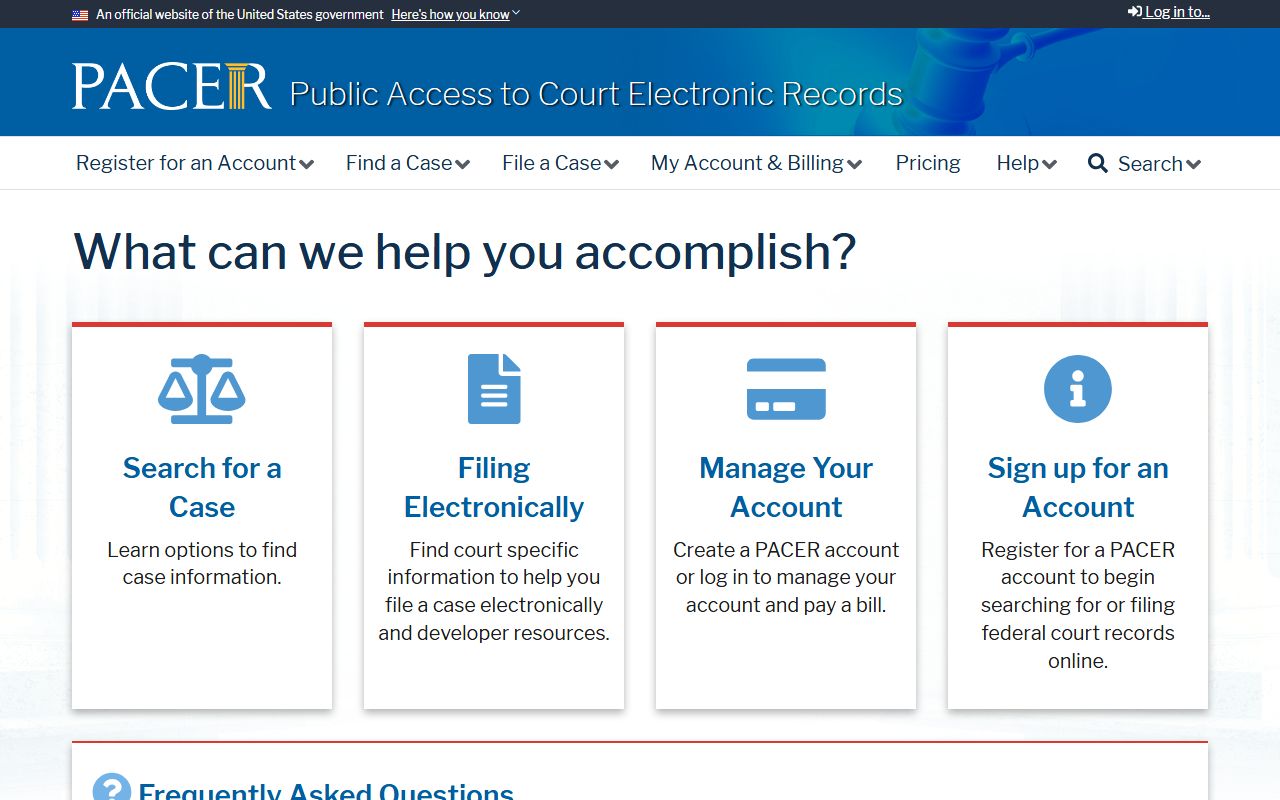
PACER charges per-page access fees and asks users to register before they search. It is the official home for federal case data, so a federal traffic matter from Summit County would appear there rather than in a county portal. The district court itself publishes the local rules, the judges, and the clerk's office that handle these cases.
To confirm the right federal venue, start at the district court site. The image below shows the U.S. District Court for the Northern District of Ohio.
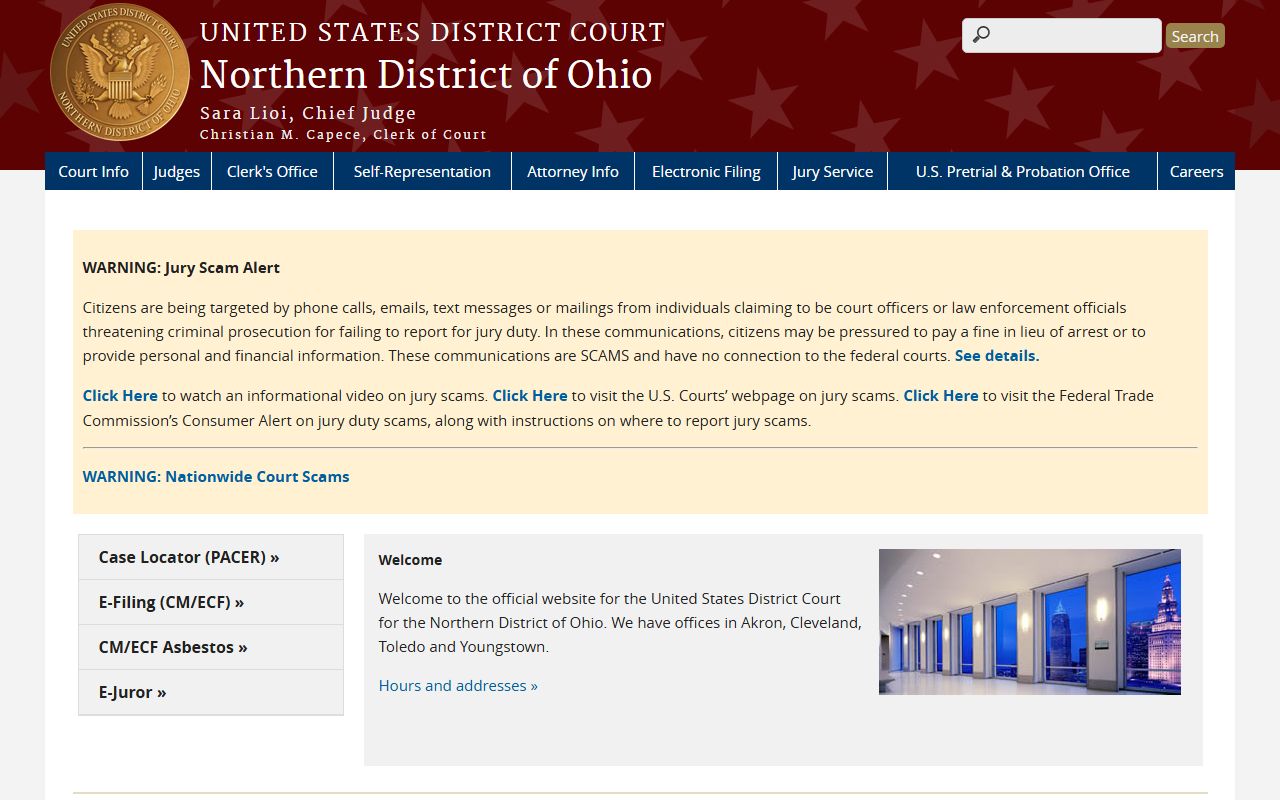
The Northern District has offices in Akron, Cleveland, Toledo, and Youngstown, so a Summit County federal matter is often handled close to home. Bankruptcy and appeals follow separate federal courts, but for a federal traffic charge, the district court and PACER are the right starting points.
Fees for Traffic Record Copies
Copy fees for a traffic record depend on the court that holds it. The municipal court traffic fees were not captured for this page, so the right move is to ask the court named on your ticket for its current copy and certification rates. The figures below come only from the Summit County Clerk of Courts court-record fee schedule, which applies to Common Pleas and the other courts the clerk serves, not to the municipal courts.
| Item | Amount |
|---|---|
| Copies, per page (Clerk of Courts) | $0.10 |
| Computer docket printouts, per page | $0.10 |
| Certified copies, per page | $1.00 |
| Authentication / exemplification / triple seal | $5.00 |
| Municipal court traffic copy fees | Confirm with the municipal court |
For OVI or other matters handled by the Court of Common Pleas, the clerk's rates above apply, and certified copies cannot be sent by email. For a routine municipal traffic ticket, call the court on your ticket and ask what a plain or certified copy costs there. More clerk detail is on the Summit County Clerk of Courts page.